
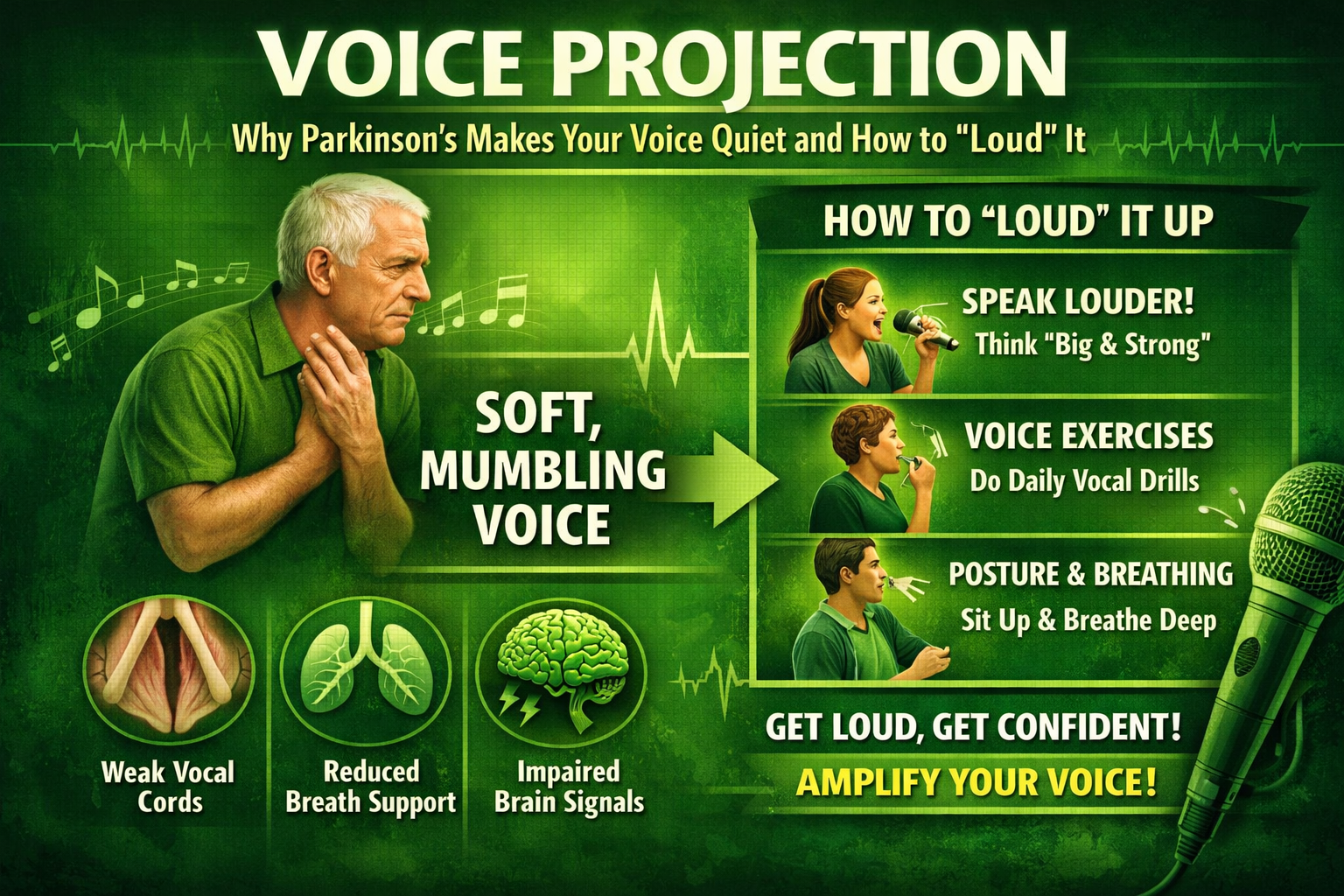
Voice projection is something most of us take for granted—until it begins to fade. For individuals living with Parkinson’s disease, a softer, weaker voice is one of the most common yet overlooked symptoms. This condition can make communication difficult, affect confidence, and even lead to social withdrawal.
In this blog, we’ll break down why Parkinson’s impacts voice projection and most importantly, how you can improve vocal strength and clarity.
You Can Read Also : The ‘Silent’ Fall Risk: How Inner Ear Issues Affect Balance & the Role of Physical Therapy
What Is Voice Projection?
Voice projection refers to your ability to produce a clear, strong, and audible voice without straining. It depends on proper coordination between:
- Breathing (lungs & diaphragm)
- Vocal cords (larynx)
- Mouth, lips, and tongue
When all these systems work together, your voice carries naturally. But in Parkinson’s, this coordination gets disrupted.
Why Parkinson’s Makes Your Voice Quiet
A quiet voice in Parkinson’s is medically called hypophonia, and it affects up to 85–90% of people with the condition.
Here are the key reasons:
1. Reduced Dopamine Affects Muscle Control
Parkinson’s reduces dopamine levels in the brain, which controls movement. This leads to:
- Slower and weaker muscle movements
- Reduced vocal cord activity
- Less force in speech
As a result, your voice becomes softer and harder to hear.
2. Weak Breathing Support
Voice projection requires strong airflow from the lungs. Parkinson’s can weaken:
- Diaphragm function
- Rib cage movement
This limits airflow, making it difficult to speak loudly or sustain sentences.
3. Muscle Rigidity and Coordination Issues
Stiff muscles in the:
- Throat
- Face
- Mouth
make speech less clear and less powerful. This condition is called hypokinetic dysarthria.
4. Reduced Awareness of Voice Volume
Many people with Parkinson’s don’t realize their voice is getting quieter. They may feel like they’re speaking loudly—even when they’re not.
5. Monotone and Expression Loss
Parkinson’s also affects emotional expression, leading to:
- Flat tone
- Less variation in pitch
- Reduced vocal energy
This makes speech less engaging and harder to understand.
You Can Read Also : Concussion Recovery in Adults: Why You Can’t Just “Sleep It Off”
Common Voice Symptoms in Parkinson’s
- Soft or whisper-like voice
- Mumbling or slurred speech
- Monotone speaking style
- Difficulty starting or finishing sentences
- Voice fatigue (gets weaker over time)
How to Improve Voice Projection in Parkinson’s
The good news: voice issues can be improved with the right therapy and exercises.
1. Speech Therapy (Most Effective Solution)
Speech-language therapy is considered the gold standard treatment.
One of the most effective programs is:
- LSVT LOUD therapy
- Focuses on speaking louder
- Improves clarity and breathing
- Requires consistent practice
Studies show it can significantly improve vocal strength and communication.
2. Practice “Think Loud” Technique
Train your brain to:
- Intentionally speak louder
- Over-exaggerate speech
- Open your mouth wider
This helps rebuild the habit of strong voice projection.
3. Breathing Exercises
Stronger breathing = stronger voice.
Try:
- Deep belly breathing
- Sustained vowel sounds (like “aaaah”)
- Controlled exhalation exercises
4. Posture and Body Position
Good posture improves airflow:
- Sit or stand upright
- Keep chin slightly lifted
- Relax shoulders
5. Daily Voice Practice
Consistency is key:
- Read aloud daily
- Practice speaking in front of a mirror
- Record and evaluate your voice
6. Reduce Background Noise
A quiet environment helps you:
- Speak with less strain
- Be heard more clearly
7. Use Assistive Devices (If Needed)
In some cases:
- Voice amplifiers
- Communication apps
can support daily interactions.
You Can Read Also : Chore Charts by Age: How Heavy Work (Helping Around the House) Calms the Nervous System with Occupational Therapy
When Should You Seek Help?
You should consult a specialist if:
- People frequently ask you to repeat yourself
- Your voice feels weaker than before
- You struggle to communicate in groups
Early intervention can prevent further decline and improve quality of life.
How CareFirst PT Can Help

At Care First Physical Therapy, we focus on personalized rehabilitation programs for neurological conditions like Parkinson’s.
Our approach includes:
- Speech and communication support
- Breathing and posture training
- Functional therapy for daily life improvement
With the right guidance, improving your voice projection is absolutely possible.
Conclusion
Voice changes in Parkinson’s are not just a minor inconvenience—they can deeply affect communication and confidence. The primary reason behind a quieter voice is reduced muscle control, breathing limitations, and lack of awareness.
However, with speech therapy, targeted exercises, and consistent practice, individuals can regain stronger voice projection and improve their quality of life.
If you or a loved one is experiencing these symptoms, early action can make a significant difference.
FAQs
1. Why does Parkinson’s cause a soft voice?
Parkinson’s affects muscle control and breathing, reducing the strength and coordination needed for voice projection, leading to a softer voice.
2. Can voice projection improve in Parkinson’s patients?
Yes, with speech therapy (especially LSVT LOUD), breathing exercises, and consistent practice, voice strength can significantly improve.
3. What is hypophonia in Parkinson’s disease?
Hypophonia is a condition where the voice becomes abnormally soft and weak, commonly seen in Parkinson’s patients.
4. How long does speech therapy take to show results?
Programs like LSVT LOUD typically run for about 4 weeks, with noticeable improvements during and after therapy.
5. Can I prebook therapy sessions for customized care?
Yes, it is always recommended to prebook therapy sessions as customized treatment plans require proper evaluation and preparation time.