
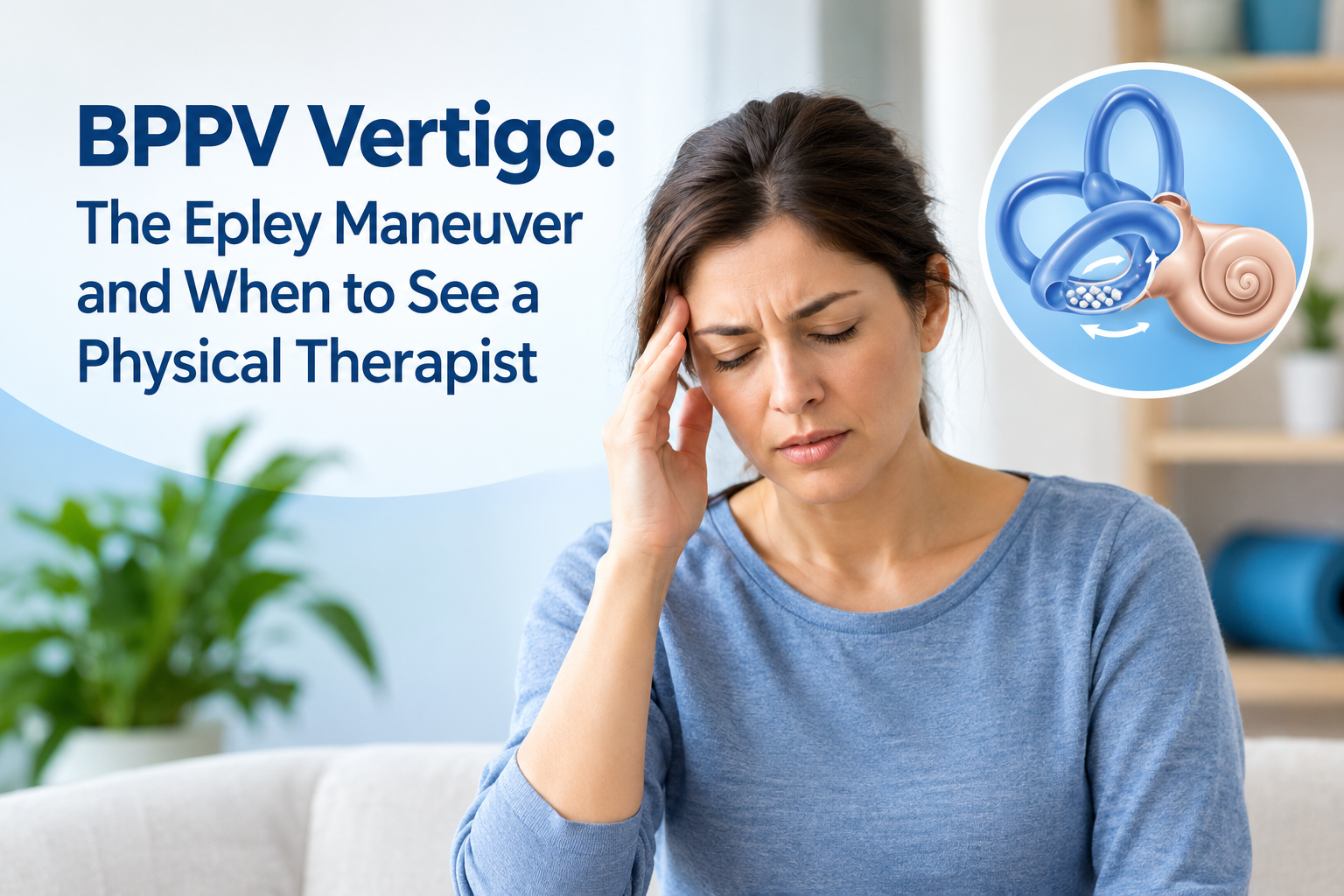
You roll over in bed, tip your head back to reach a high shelf, or bend down to tie your shoes, and suddenly the room spins. It lasts less than a minute, but it’s frightening, and you start moving more carefully just in case it happens again.
If this sounds familiar, you may have BPPV, the most common cause of vertigo. The good news is that it’s usually very treatable, often in just a few visits. This guide explains what BPPV is, how the Epley maneuver works, and when to see a physical therapist.
What Is BPPV?
BPPV stands for benign paroxysmal positional vertigo. Each word describes part of the condition:
- Benign: it isn’t life-threatening
- Paroxysmal: it comes on suddenly in short episodes
- Positional: it’s triggered by certain head positions
- Vertigo: a false sensation that you or the room is spinning
Read More: Hypotonia (Low Muscle Tone) in Babies and Toddlers: Signs, Causes & How Physical Therapy Helps
What causes it?
Your inner ear contains tiny calcium carbonate crystals called otoconia (sometimes called “ear rocks”). They normally sit in a part of the inner ear that senses gravity and head position.
In BPPV, some of these crystals break loose and drift into the semicircular canals, the fluid-filled tubes that detect rotation. When you move your head, the loose crystals shift and send false signals to your brain. Your eyes and your balance system disagree about how you’re moving, and the result is a brief, intense spinning sensation.
Who is most likely to get BPPV?
- Adults over 50, and risk increases with age
- Women, who are affected more often than men
- People who’ve had a head injury or whiplash
- People with a history of migraine
- People who’ve had prolonged bed rest or long periods lying in one position
- People who’ve had other inner ear problems
Many cases have no clear cause.
Common Symptoms of BPPV
- Brief spinning episodes that usually last under a minute
- Triggered by rolling over in bed, looking up, bending forward, or lying down or sitting up
- Lightheadedness or a feeling of being off-balance afterward
- Nausea, and sometimes vomiting
- Eye movements (a jerking motion called nystagmus) during an episode
- Feeling unsteady for hours after an attack
BPPV typically doesn’t cause hearing loss, ringing in the ears, or severe headache. If you have those symptoms, a different cause may be involved, so see your doctor.

Why BPPV Raises Your Fall Risk
Vertigo is more than uncomfortable. People with BPPV often become unsteady and cautious, and dizziness is a recognized fall risk factor, especially for older adults. Some people start avoiding movements, which can lead to stiffness, weakness, and lower confidence. Getting an accurate diagnosis and treatment early helps you stay safe and active. For more on how the inner ear affects balance, see our post on [the “silent” fall risk from inner ear issues].
When Is Vertigo an Emergency?
Most vertigo isn’t dangerous, but some causes are serious. Call 911 or go to the emergency room right away if vertigo comes with:
- Sudden, severe headache
- Double vision or loss of vision
- Slurred speech or trouble speaking
- Weakness, numbness, or tingling in the face, arm, or leg
- Facial drooping
- Trouble walking, or being unable to stand
- Chest pain, a fast or irregular heartbeat, or fainting
- Dizziness after a head injury
Vertigo that is constant (not triggered by position), lasts for hours or days, or comes with new hearing loss should also be evaluated promptly by a doctor.
How Is BPPV Diagnosed?
BPPV is diagnosed with a simple bedside test, not usually with scans. The most common is the Dix-Hallpike test: a clinician moves you from sitting to lying down with your head turned to one side while watching your eyes for a specific pattern of movement. A different test (the supine roll test) is used when the horizontal canal is involved.
This test tells your clinician:
- Whether you have BPPV at all
- Which ear is affected
- Which canal the crystals are in
That information matters because the treatment depends on the exact ear and canal. The same movement that fixes one type can be ineffective, or make symptoms worse, for another.
What Is the Epley Maneuver?
The Epley maneuver is a series of slow, deliberate head and body position changes designed to move the loose crystals out of the semicircular canal and back to where they belong, so they stop triggering false signals.
It’s the best-known treatment for the most common form of BPPV, which involves the posterior canal.
How it works, in general terms
Your clinician guides you through a sequence of four positions, usually with about 30 to 60 seconds in each:
- Sitting, with your head turned about 45 degrees toward the affected ear
- Lying back quickly with your head hanging slightly over the edge of the table, still turned
- Head turned to the opposite side
- Rolling onto your side and then sitting back up
During the maneuver you may feel a short bout of spinning, which usually means it’s working as the crystals move.
Read More: Physical Therapy vs. Chiropractor: Which One Do You Need?
Does it work?
For many people, one or a few treatment sessions relieve symptoms, and the Epley maneuver is widely recommended in clinical guidelines for posterior canal BPPV. Results vary by person and type of BPPV.
Can I do the Epley maneuver at home?
This is one of the most common questions, and the honest answer is: start with a proper diagnosis.
- You need to know which ear and canal are involved. Doing the maneuver for the wrong ear or wrong type can be ineffective and may increase dizziness.
- Not all dizziness is BPPV. Doing head maneuvers when the cause is something else can delay proper care.
- Safety matters. Rapid position changes can make you sick or unsteady, and falling is a real risk. Some people with neck or back problems, certain eye or heart conditions, or other medical issues shouldn’t do the maneuver without guidance.
Some people are taught a home version after being properly diagnosed. If you’re taught it, follow your therapist’s exact instructions, have someone nearby, and do it on a bed or other safe surface.
What to expect afterward
- You may feel unsteady or mildly dizzy for the rest of the day
- Your clinician may suggest taking it easy and being careful with sudden head movements for a short period
- Symptoms often improve within days, though some people need more than one session
Instructions after treatment vary by clinician, so follow the guidance your provider gives you.
When to See a Physical Therapist for BPPV
A physical therapist trained in vestibular rehabilitation can diagnose and treat many types of BPPV and address the balance problems that come with it. Consider booking an evaluation if:
- You feel spinning when you roll over, lie down, or look up
- Your dizziness comes in short episodes triggered by head movement
- You’ve had dizziness for days or weeks and want to know why
- You feel unsteady or afraid of falling
- You’ve been told you have BPPV and want help treating it
- The dizziness has come back after earlier treatment
- Your doctor has ruled out more serious causes and suggested therapy
It’s wise to mention new dizziness to your doctor as well, especially if it’s your first episode, so other causes can be ruled out.
What Happens at a Vestibular PT Visit
Here’s what a typical evaluation and treatment may involve:
- A detailed history, including what triggers your dizziness, how long it lasts, and any recent injuries, illnesses, or medications
- Screening for red flags that need medical attention first
- Positional testing, such as the Dix-Hallpike or roll test, to identify the affected ear and canal
- Canal repositioning treatment, such as the Epley maneuver or another maneuver matched to your type of BPPV
- Balance and gait assessment to check your stability and fall risk
- A personalized plan, which may include balance exercises and guidance on what to do if symptoms return
- Education on safe movement, sleep positioning, and when to call your doctor
If your evaluation points to something other than BPPV, your therapist will refer you back to your physician.
What About Dizziness That Lingers After BPPV Treatment?
Some people feel unsteady even after the spinning has stopped. This can happen because your balance system has been disrupted and your brain needs time to recalibrate. Vestibular rehabilitation can help with:
- Gaze stability exercises
- Balance and walking retraining
- Gradual exposure to movements that cause dizziness
- Confidence and safety strategies for everyday activities
Can BPPV Come Back?
Yes. BPPV can recur, sometimes months or years later. This doesn’t mean treatment failed. If symptoms return, a new evaluation can confirm whether it’s BPPV again and, if so, which canal is involved so the right maneuver can be used.
Tips for Managing BPPV Safely
- Move slowly when changing positions, especially getting out of bed
- Sit on the edge of the bed for a moment before standing
- Remove tripping hazards and use night lights
- Avoid driving or using ladders while you’re having dizzy spells
- Stay hydrated and keep up with regular activity as advised by your provider
- Keep a symptom diary noting triggers, duration, and which direction you turned. It helps your therapist.
Read More: Frozen Shoulder Stages and Recovery Timeline: What to Expect
How Care First Rehab Can Help
At Care First Rehab in Cary, NC, our physical therapists evaluate and treat dizziness and balance problems so you can move through your day with more confidence. Our approach includes:
- A thorough evaluation to understand your symptoms and screen for concerns that need a physician
- Hands-on treatment and guided exercises matched to your needs
- Balance and fall-prevention training for adults who feel unsteady
- A clear home plan and education on what to do if symptoms return
- Coordinated care with your physician and other providers when needed
- In-home therapy options for patients who find it hard to travel
- Two convenient locations in Cary
Frequently Asked Questions
Is BPPV serious?
BPPV itself isn’t dangerous, but the dizziness can raise your risk of falling and can be very unpleasant. Other conditions that cause vertigo can be serious, which is why a proper evaluation matters.
How long does BPPV last without treatment?
BPPV sometimes clears on its own over weeks to months, but it can last longer and may return. Treatment can often shorten the course.
How many Epley treatments will I need?
Some people improve after one session, while others need a few. It depends on the type of BPPV and how your body responds.
Can I tell which ear is affected on my own?
It’s hard to be sure without testing. The direction you turn when the spinning starts can offer a clue, but a clinician’s exam is the reliable way to know.
Is BPPV the same as vertigo?
Vertigo is a symptom (the spinning feeling), and BPPV is one cause of it. Others include inner ear infections, vestibular migraine, and Meniere’s disease.
Can neck problems cause BPPV?
BPPV comes from the inner ear, not the neck, but neck stiffness can make it harder to do positioning tests and maneuvers. Your therapist can adapt the approach.
Should I see my doctor or a physical therapist first?
If it’s your first episode of dizziness or you have any warning signs listed above, see your doctor first. If your symptoms match BPPV and serious causes have been ruled out, a vestibular physical therapist can treat it directly.
Stop Letting Dizziness Slow You Down
You don’t have to live in fear of rolling over in bed or looking up at a shelf. With the right diagnosis and treatment, many people get lasting relief.
Call Care First Rehab at 919-460-1921 or [book an appointment online] to schedule your dizziness and balance evaluation.