
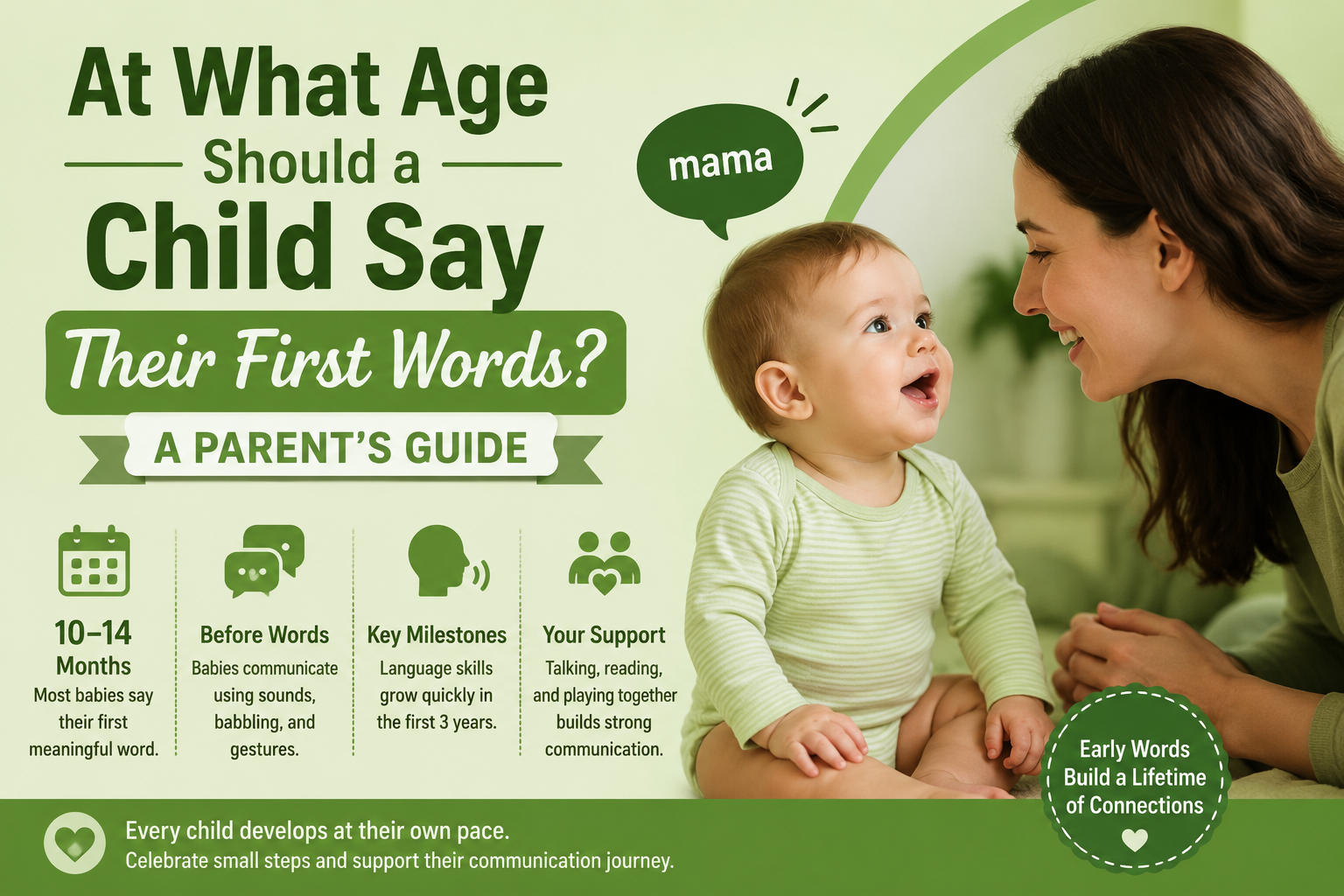
One of the most heartwarming milestones in parenthood is hearing your child speak their first word. Whether it’s “mama,” “dada,” or another familiar sound, those early attempts at communication signal a beautiful stage of growing language development. Naturally, many parents find themselves asking: At what age should a child say their first words?
While every child develops at their own unique pace, there are general speech and language milestones that can help parents recognize what is considered typical development — and when it may be time to seek professional guidance.
When Do Most Children Say Their First Words?
Most babies say their first meaningful word between 10 and 14 months of age. These words are typically simple and connected to familiar people, objects, or everyday routines.
Common first words include:
- Mama
- Dada
- Bye-bye
- Ball
- Dog
- More
- Hi
A meaningful word is one that a child uses consistently to refer to a specific person, object, or action — not just random sounds.
Speech and Language Development Before First Words

Understanding how babies develop speech and language skills before saying their first words.
Long before a child utters their first word, they are quietly learning how communication works. Language development actually begins in infancy, well before any words are spoken.
Birth to 6 Months
During this early stage, babies:
- Respond to sounds and familiar voices
- Smile and engage socially
- Begin making cooing sounds
- Start recognizing the voices of loved ones

6 to 12 Months
As babies grow, they typically:
- Babble using sounds like “ba-ba” and “da-da”
- Respond to their own name
- Begin understanding simple words
- Use gestures such as pointing or waving
Babbling is a vital stepping stone toward spoken language, giving children the opportunity to practice and refine speech sounds.
Language Milestones by Age
By 12 Months, most children:
- Say one or more meaningful words
- Understand simple commands
- Use gestures to express themselves
By 18 Months, most children:
- Have a vocabulary of 10 to 50 words
- Point to objects when they are named
- Begin imitating words they hear
By 24 Months, most children:
- Use at least 50 words
- Start combining two words together
- Follow simple directions
- Ask basic questions
By 3 Years, most children:
- Speak in short, clear sentences
- Use hundreds of words
- Participate in back-and-forth conversations
- Are understood by familiar adults most of the time
Why Some Children Talk Later Than Others
Several factors can influence the pace of speech and language development, including:
- Individual Development Differences — Children naturally develop at different rates. Some begin speaking earlier, while others simply need a little more time.
- Family History — A family history of speech or language delays may play a role in a child’s communication development.
- Hearing Difficulties — Since children learn language primarily through listening, any hearing problems can directly impact speech development.
- Developmental Conditions — Certain developmental or neurological conditions may contribute to delayed speech and language skills.
- Limited Communication Opportunities — Children thrive with regular interaction, conversation, reading, and play with their caregivers.
Signs Your Child May Need a Speech Evaluation
While some variation in development is completely normal, parents should consider seeking professional advice if their child:
- Is not babbling by 9 months
- Does not respond to their name by 12 months
- Is not saying any meaningful words by 15 to 18 months
- Has difficulty understanding simple directions
- Rarely uses gestures such as pointing or waving
- Shows little interest in communicating with others
- Is not combining words by age 2
Early evaluation can help identify potential concerns and provide timely guidance for supporting your child’s communication development.
How Parents Can Encourage First Words
There are many simple, effective ways to nurture language development at home:
- Talk Throughout the Day — Describe everyday activities, familiar objects, and daily routines as you go about your day.
- Read Together Daily — Books introduce children to new vocabulary and strengthen their listening skills.
- Respond to Communication Attempts — Acknowledge gestures, sounds, and words to reinforce your child’s desire to communicate.
- Limit Passive Screen Time — Face-to-face interaction provides far richer opportunities for language learning than screen exposure.
- Encourage Turn-Taking — Simple back-and-forth exchanges, even before real words emerge, help lay the foundation for strong communication skills.
You Can Read also : The ‘Silent’ Fall Risk: How Inner Ear Issues Affect Balance & the Role of Physical Therapy
When Should Parents Seek Speech Therapy?
If you have any concerns about your child’s communication development, it is always better to seek guidance early rather than wait and wonder.
A qualified speech-language pathologist can:
- Evaluate your child’s speech and language skills
- Identify any developmental delays
- Create an individualized treatment plan
- Provide practical strategies to support communication at home
Early intervention consistently leads to better outcomes and equips children with the skills they need to thrive at home, in school, and in social settings.
Why Families Trust Care First Rehabilitation
At Care First Rehabilitation, experienced speech-language pathologists provide thorough evaluations and personalized speech therapy services for children of all ages.
Their dedicated team helps children:
- Develop age-appropriate communication skills
- Improve speech clarity and articulation
- Expand vocabulary and overall language abilities
- Strengthen social communication
- Build confidence through meaningful, effective communication
Every therapy plan is thoughtfully tailored to meet the unique needs of the child and their family.
Schedule a Speech Evaluation Today
If your child is not meeting speech milestones or you are concerned about delayed language development, professional support can make a truly meaningful difference.
Care First Rehabilitation offers compassionate, evidence-based speech therapy services designed to help children reach their full communication potential.
👉 Learn more or schedule an evaluation:
https://carefirstpt.com/speech-therapy/
Frequently Asked Questions
Is it normal if my child isn’t talking at 12 months?
Some children begin speaking slightly later than others, and this can be perfectly normal. However, if you have any concerns about your child’s communication development, it is always a good idea to discuss them with a pediatrician or speech-language pathologist.
What is considered a child’s first word?
A first word is a meaningful word that a child uses consistently to refer to a specific person, object, or action — not simply a repeated sound.
Should I worry if my child only says a few words at 18 months?
Not necessarily. However, if vocabulary growth appears limited or other communication milestones seem delayed, scheduling an evaluation with a professional may be beneficial.
Can speech therapy help toddlers who are not talking?
Absolutely. Early speech therapy can be highly effective in helping children develop communication skills and address any underlying speech or language challenges.
Does bilingual exposure cause speech delay?
Research clearly shows that learning more than one language does not cause speech delays. Bilingual children may distribute vocabulary across both languages, but they continue to develop language skills normally overall.
You Can Read also : Voice Projection: Why Parkinson’s Makes Your Voice Quiet and How to “Loud” It