
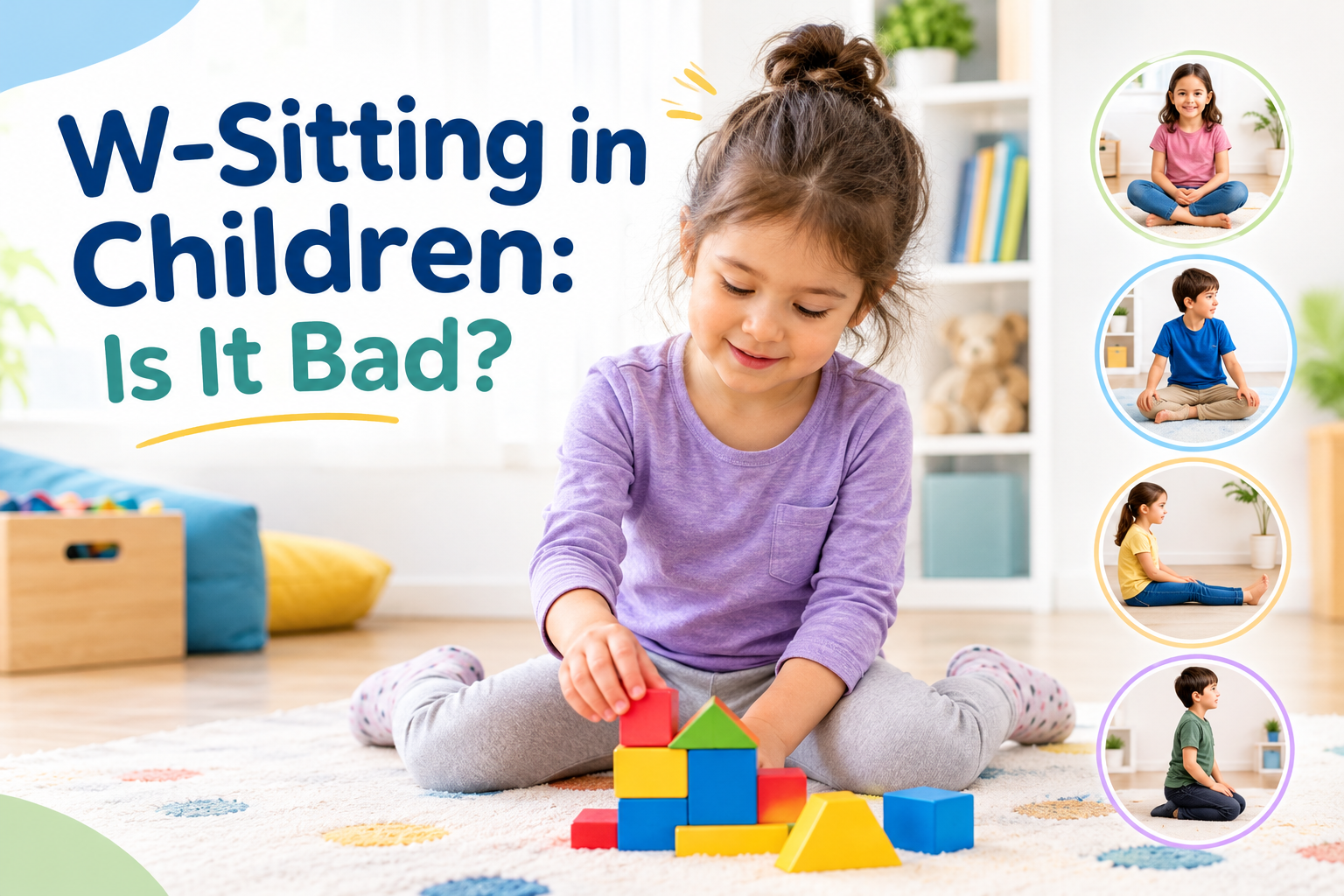
You glance over at your child playing on the floor and notice they’re sitting with their knees bent and their legs tucked out to the sides, so their legs form the shape of a “W.” Then you remember a comment from a relative, a teacher, or a parenting group: “They shouldn’t sit like that.”
Now you’re wondering whether you should be worried.
W-sitting is very common in young children, and the answer is more nuanced than “good” or “bad.” This guide explains what W-sitting is, why kids do it, when it’s worth paying attention to, and how to encourage a wider variety of sitting positions.
What Is W-Sitting?
W-sitting is a floor-sitting position where a child sits on their bottom with their knees bent in front of them and their feet positioned outside their hips. When you look at the child from above or in front, the legs form a “W” shape. Some children also sit with their legs tucked behind, in the shape of a “reverse tailor” or “reverse indian” position.
It’s especially common in toddlers and preschoolers, and many children do it for a stretch of time and then move on.
Read More: BPPV Vertigo: The Epley Maneuver and When to See a Physical Therapist
Why Do Kids W-Sit?
For many children, it’s simply the easiest and most stable way to sit. The wide base of the “W” gives a lot of support, which frees up their hands to play. Common reasons include:
- It feels stable. The position needs very little effort from the core and trunk muscles.
- Flexible joints. Children with naturally flexible hips find it comfortable.
- Low muscle tone (hypotonia). Children who tire easily or have weaker core muscles may choose positions that give extra support.
- Tight muscles. Tightness in the hamstrings or other leg muscles can make cross-legged or long sitting uncomfortable.
- Habit. Once a child finds a position that works, they may return to it often.
- Developmental differences, including coordination challenges or motor delays.

Is W-Sitting Bad for Kids?
This is the question most parents want answered, and honest information is important here.
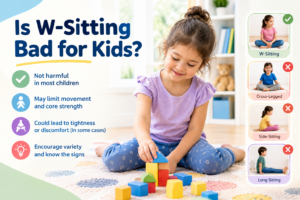
W-sitting isn’t known to cause serious damage in typical, healthy children. Occasional W-sitting is very common and is generally not a cause for alarm. You may have heard claims that it causes hip problems or other orthopedic conditions, but the evidence for those claims is limited.
That said, many pediatric therapists recommend not letting W-sitting become a child’s only way to sit, for these reasons:
- It limits movement variety. In W-sitting, children tend to stay in one position and avoid twisting their trunk, so they may miss out on practicing rotation and weight shifting, which are important for coordination and balance.
- It can reduce core and trunk engagement. Because the position is so stable, it may give the core muscles less work to do.
- It may mask underlying issues. A child who always W-sits may be avoiding other positions because they feel hard, which can be a clue about strength, tone, or flexibility.
- It may add to tightness. Staying in this position for long periods may contribute to tightness in some muscles for some children.
- It may affect play. It can be harder to reach across the body, switch hands, and move between positions from W-sitting, which are skills children use in play and daily activities.
- It can be uncomfortable for some children, especially those with certain hip or leg conditions.
So the more accurate answer is: W-sitting is usually not dangerous, but it’s worth encouraging variety, and it’s worth noticing why your child prefers it.
Read More: Hypotonia (Low Muscle Tone) in Babies and Toddlers: Signs, Causes & How Physical Therapy Helps
When to Pay Closer Attention
Occasional W-sitting is normal. Consider talking with your pediatrician or a pediatric physical therapist if your child:
- W-sits almost all the time, and resists or can’t sit comfortably in other ways
- Seems uncomfortable, stiff, or in pain when sitting or getting up
- Is late to reach motor milestones such as sitting, crawling, or walking
- Appears floppy, tires easily, or avoids physical play
- Often trips, falls, or seems clumsy compared to peers
- Walks on their toes or has an unusual walking pattern
- Has turned-in feet or other changes in how their legs line up when walking
- Has been diagnosed with a condition affecting tone, muscles, or joints, such as cerebral palsy, Down syndrome, or another developmental condition
- Cannot stay upright or balanced in other sitting positions
If your child was recently diagnosed with a hip or orthopedic condition, ask their doctor specifically about sitting positions, since recommendations can differ.
Having one of these signs doesn’t mean something is wrong, but it’s a good reason to have a professional take a look.
Healthier Sitting Alternatives to Encourage
The goal isn’t to scold your child or force them into a position. It’s to offer a variety of options so they build strength and flexibility in many positions. Some alternatives include:
- Criss-cross sitting (cross-legged): a classic position that builds core and hip flexibility. Younger children may need a little time to master it.
- Side-sitting: both legs bent to one side. Try alternating sides so the child doesn’t favor one.
- Long sitting: legs stretched straight out in front. This gently stretches the hamstrings.
- Short sitting on a low bench or stool: this encourages upright posture and lets feet rest on the ground.
- Kneeling or half-kneeling: helps build hip and core strength.
- Tummy play and floor play: especially for babies and toddlers.
- Sitting at a small table and chair: useful for activities like drawing and snack time, with feet supported if possible.
Practical Tips for Parents
- Stay calm and positive. Use gentle reminders, such as “Let’s try sitting like a pretzel,” instead of “Stop sitting like that!” A child who feels criticized may resist more.
- Make it fun. Songs, games, and storytime in a different position can help. Try a “sitting-position challenge” where everyone tries a new way to sit.
- Offer supports. A small cushion, a bean bag, a sit-and-play seat, or a low stool may help your child feel stable in other positions.
- Add variety through play, such as playing on their tummy, kneeling at a low table, or crawling through tunnels.
- Don’t force a position. If your child consistently can’t or won’t sit in other ways, that’s information worth sharing with a therapist.
- Give it time. Changing a habit takes repetition and patience, especially in toddlers.
- Make the environment work for you. Seat children at an appropriate-height table, with their feet supported where possible.
What Pediatric Physical Therapy Can Do

A pediatric physical therapist looks at the bigger picture of how your child moves, not just at how they sit. An evaluation may look at:
- Core and trunk strength
- Muscle tone and flexibility
- Hip and leg alignment
- Balance and coordination
- Gross motor milestones
- How your child transitions between positions, such as floor to standing
If there’s a reason your child favors W-sitting, therapy can address it directly. Depending on your child’s needs, this may include:
- Strengthening the core and trunk through games and play
- Gentle stretching for tight muscles
- Practice in alternative sitting positions with the right amount of support
- Balance and coordination activities
- Parent coaching with simple strategies for home and school
Therapy is play-based and age-appropriate, so sessions feel like fun rather than exercise. If your child’s challenges go beyond movement, such as fine motor skills, handwriting, self-care, or feeding, our occupational and speech therapists can also be involved.
Read More: Frozen Shoulder Stages and Recovery Timeline: What to Expect
How Care First Rehab Can Help
At Care First Rehab in Cary, NC, our pediatric therapy team helps families understand what’s behind their child’s movement habits and builds a plan to support them. Our care includes:
- A thorough evaluation of your child’s strength, flexibility, balance, and motor skills
- Play-based, family-centered treatment tailored to your child
- Simple, realistic home strategies that fit into your family’s routine
- Coordinated care across physical, occupational, and speech therapy when needed
- In-home therapy and telemedicine options for families who need flexibility
- Two convenient locations in Cary
You don’t have to figure it out alone. If W-sitting is a regular habit and you’re not sure what it means, we can help you find out.
Frequently Asked Questions
Is W-sitting bad for toddlers?
Occasional W-sitting is common and usually not harmful. It’s still helpful to encourage other sitting positions so your child builds strength, flexibility, and coordination.
At what age should a child stop W-sitting?
There’s no exact age. Many children outgrow it as their core strength and balance improve. If your child still W-sits most of the time as they get older, or has other concerns, ask your pediatrician or a pediatric physical therapist.
Does W-sitting cause hip dysplasia or pigeon toes?
There’s no strong evidence that W-sitting causes these conditions in typical children. If you notice turned-in feet or concerns about hip alignment, have your pediatrician check, since these can have other causes.
Should I stop my child from W-sitting?
You don’t need to be strict or anxious about it. Gently encourage other positions and offer variety. If your child can only sit this way, or it seems uncomfortable, get an evaluation.
Is W-sitting a sign of a developmental delay?
Not by itself. Most children who W-sit are developing normally. However, if it comes with delayed milestones, low muscle tone, clumsiness, or other concerns, it’s worth getting checked.
Can W-sitting affect handwriting or school skills?
Sitting posture and core stability can influence how comfortably a child sits at a desk and uses their hands. If your child struggles with sitting still, posture, or fine motor tasks, an evaluation can help.
Will therapy “fix” W-sitting?
Therapy focuses on helping your child become stronger and more comfortable in a variety of positions, so W-sitting becomes one choice among many rather than the only one.
Give Your Child More Ways to Move and Play
W-sitting is rarely an emergency, but it can offer clues about how your child moves. A few small changes at home, and a professional opinion when needed, can help your child build the strength and flexibility to sit and play comfortably in any position.
Call Care First Rehab at 919-460-1921 or [book an appointment online] to schedule a pediatric physical therapy evaluation