
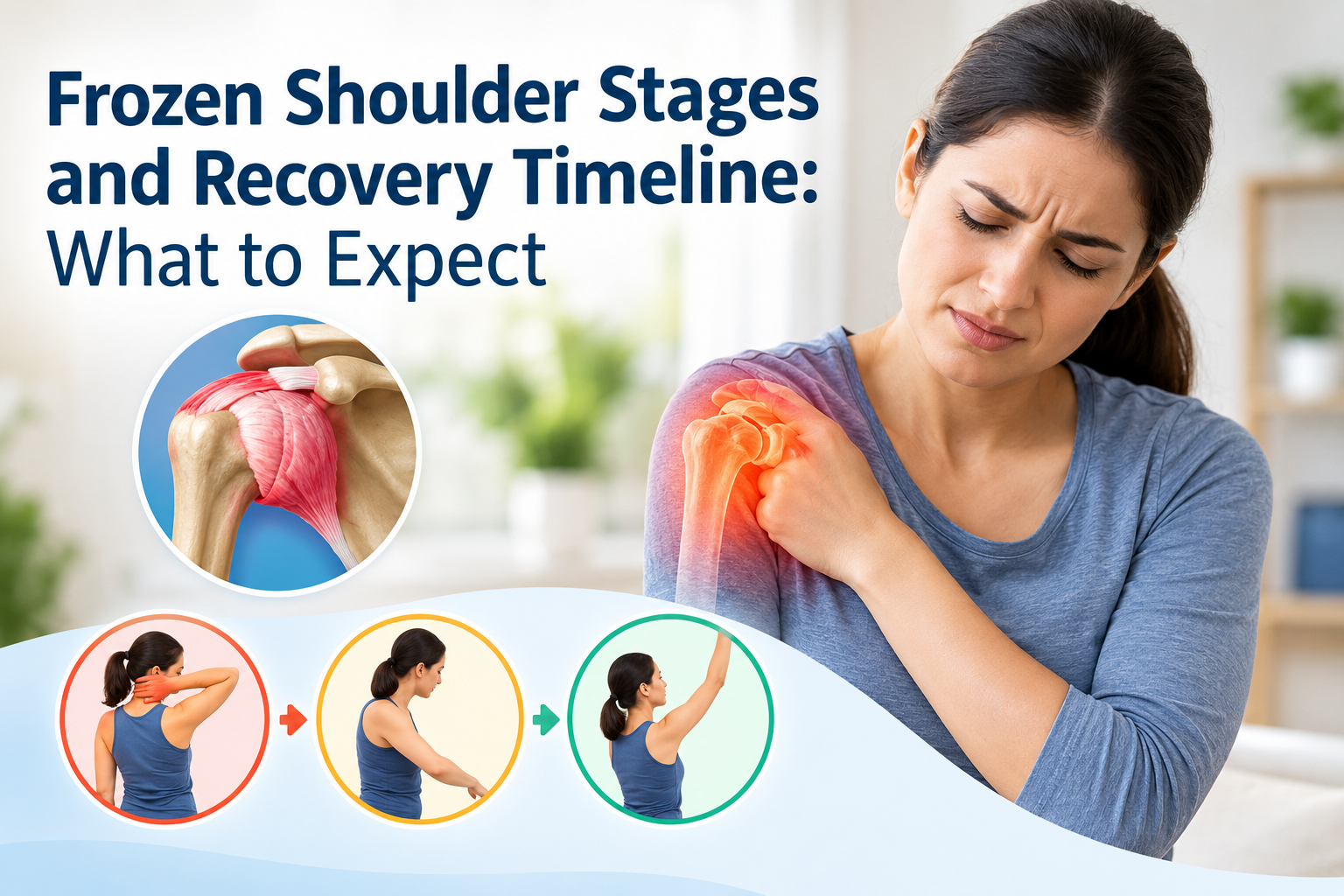
You reach for a seatbelt, a shelf, or the back of your bra or belt, and your shoulder simply won’t go there. The pain is deep, the stiffness is getting worse, and sleep is becoming a struggle. If this sounds familiar, you may be dealing with frozen shoulder.
The good news is that frozen shoulder almost always improves. The challenge is that it takes patience, and knowing what stage you’re in makes the process much easier to manage. This guide covers the stages, a realistic recovery timeline, and how physical therapy can help.
What Is Frozen Shoulder?
Frozen shoulder, medically called adhesive capsulitis, happens when the connective tissue surrounding the shoulder joint (the capsule) becomes inflamed, thick, and tight. This restricts movement and causes pain, often worse at night.
It’s different from ordinary shoulder soreness. With a frozen shoulder, you can’t lift your arm much even when someone else tries to move it for you. That is a key clue that the joint itself has stiffened.
Read More: Physical Therapy vs. Chiropractor: Which One Do You Need?
Who Is Most at Risk?
- People aged 40 to 60
- Women, who are affected more often than men
- People with diabetes, who have a notably higher risk
- People with thyroid conditions
- Anyone whose shoulder has been immobilized, such as after surgery, a fracture, or a sling
- People with certain conditions, such as Parkinson’s disease or heart disease
Frozen shoulder can also appear without any clear cause.

The 3 Stages of Frozen Shoulder
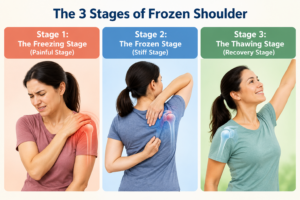
Frozen shoulder moves through three overlapping stages. The durations below are typical ranges, and they vary widely from person to person.
Stage 1: The Freezing Stage (Painful Stage)
Typical length: about 2 to 9 months
- Pain starts gradually and often worsens, especially at night
- Range of motion begins to shrink
- Reaching overhead, behind your back, or out to the side becomes uncomfortable
This is often the most painful stage. Protecting sleep and calming irritation are the priorities.
Stage 2: The Frozen Stage (Stiff Stage)
Typical length: about 4 to 12 months
- Pain often eases, but stiffness is at its worst
- Daily tasks such as dressing, washing your hair, or reaching a high shelf become difficult
- Muscles may weaken from lack of use
Many people say the shoulder feels “locked.” This is the stage where a structured physical therapy program becomes especially important.
Stage 3: The Thawing Stage (Recovery Stage)
Typical length: about 5 to 24 months
- Motion slowly returns
- Pain continues to fade
- Strength and function gradually come back
Improvement is usually gradual rather than sudden.
How Long Does Frozen Shoulder Take to Heal?

Most cases resolve on their own over time, but the total timeline is often 1 to 3 years. Some people recover faster, and some are left with mild lingering stiffness. A few factors can affect your pace:
| Factor | Effect on recovery |
| Starting treatment early | Often helps maintain motion and manage pain |
| Diabetes | May lead to a longer or more stubborn course |
| Consistency with exercises | Supports steadier progress |
| Severity of stiffness | More severe cases may take longer |
| Overall health and activity level | Can influence how well you tolerate treatment |
Because recovery is slow, the goal of treatment isn’t to “rush through” the stages. It’s to keep you comfortable, protect the motion you have, and support recovery at each stage.
Read More: When Should You See an Orthopedic Physical Therapist? 10 Warning Signs
How Physical Therapy Helps at Each Stage
Physical therapy is one of the most commonly recommended first-line treatments for frozen shoulder. A good program changes as your shoulder changes.
In the freezing stage, your therapist may focus on:
- Reducing irritation with gentle, pain-limited movement
- Positioning and sleep strategies
- Teaching you what to avoid so you don’t aggravate the shoulder
In the frozen stage, your therapist may focus on:
- Gentle stretching and mobility work
- Hands-on manual therapy to help the joint and surrounding muscles move better
- Maintaining strength in the shoulder blade and upper back
In the thawing stage, your therapist may focus on:
- Progressive stretching to regain full range of motion
- Strengthening the rotator cuff and shoulder blade muscles
- Retraining normal movement for work, sports, and daily life
Occupational therapy can also help when everyday tasks become difficult. At Care First Rehab, our occupational therapists can work on practical strategies for dressing, grooming, cooking, and working while your shoulder recovers.
Home Tips to Support Recovery
These are general tips, not a substitute for an evaluation. Always check with your provider first.
- Stay gently active. Avoid completely resting the arm, since long periods without movement can add to stiffness.
- Use gentle heat before stretching, if your provider approves.
- Stop short of sharp pain. Stretching should feel like a mild pull, not a strong pain.
- Support your arm when sleeping. A pillow under or in front of the affected arm may help.
- Be consistent. Short, regular sessions usually work better than occasional long ones.
When to See a Doctor Right Away
Seek prompt medical care if you have:
- Shoulder pain with chest pressure, shortness of breath, or sweating
- Sudden severe pain after a fall or injury
- Fever, redness, or swelling around the joint
- New numbness or weakness in the arm or hand
Other Treatment Options
Your doctor may discuss additional options depending on your case, such as medication for pain and inflammation, corticosteroid injections, or, less commonly, procedures for persistent cases. Physical therapy often works alongside these and helps you make the most of the results.
How Care First Rehab Can Help
At Care First Rehab in Cary, NC, our physical therapists begin with a thorough evaluation to confirm how your shoulder is moving and what’s limiting it. Then we build a plan matched to your stage, goals, and daily needs.
- One-on-one care with a plan that adapts as your shoulder changes
- Hands-on manual therapy and guided exercise
- Home exercise programs you can follow with confidence
- Occupational therapy support for everyday tasks
- In-home therapy and telemedicine options if getting to the clinic is difficult
- Two convenient Cary locations
If you suspect a frozen shoulder, getting evaluated early gives you a clearer picture of where you are and what to expect.
Don’t Wait for Your Shoulder to “Thaw” on Its Own
You don’t have to simply wait it out. With the right guidance, you can stay comfortable, protect your motion, and get back to the things you enjoy.
Call Care First Rehab at 919-460-1921 or [book an appointment online] to schedule your shoulder evaluation
Read More: Autism in Children: Signs, Symptoms, Treatment & How Therapy Can Help
Frequently Asked Questions
How do I know if I have a frozen shoulder or a rotator cuff problem?
With frozen shoulder, both active and passive movement are limited, meaning the joint won’t move much even when someone else lifts your arm. Rotator cuff problems often cause pain and weakness, but the joint may still move more freely. A physical therapist or doctor can tell the difference with an evaluation.
Can frozen shoulder go away on its own?
Often it improves over time, but this can take one to three years. Physical therapy aims to ease pain, protect motion, and support a smoother recovery.
Should I exercise a frozen shoulder?
Gentle, guided movement is usually helpful, but forcing the shoulder or pushing through sharp pain can backfire. A therapist can tell you how much is right for your stage.
Can frozen shoulder come back?
It rarely returns in the same shoulder, but some people develop it in the other shoulder later.
Does diabetes make frozen shoulder worse?
People with diabetes are more likely to develop it, and it may take longer to resolve. Managing blood sugar and staying active with guidance can help.