
For parents, noticing that your child is developing differently can bring a lot of questions. Maybe your child is not speaking as much as other children their age, avoids eye contact, becomes overwhelmed by certain sounds, or prefers routines and familiar activities. These differences can sometimes be associated with autism spectrum disorder (ASD).
Autism is not a disease that a child simply “grows out of.” It is a developmental condition that can affect communication, social interaction, behavior, learning, and the way a child experiences the world.
The good news is that early support and individualized therapy can make a meaningful difference. With the right guidance, children with autism can develop communication, social, behavioral, and daily-living skills while building confidence and independence.
For families in Cary, North Carolina, understanding the signs of autism and knowing when to seek professional support can be an important first step.

What Is Autism?
Autism, or autism spectrum disorder (ASD), is a neurological and developmental condition that affects how a person communicates, interacts with others, learns, and behaves.
It is called a “spectrum” because autism can look very different from one child to another. One child may need significant support with communication and daily activities, while another may speak fluently but struggle with social situations, sensory sensitivity, or changes in routine.
There is no single personality, behavior pattern, or level of ability that defines autism.
Some children with autism may have strong interests, excellent memory, creative thinking, or unique problem-solving abilities. Others may need more support with communication, learning, or everyday tasks.
The goal of therapy is not to change who a child is. Instead, appropriate support should help the child communicate, participate, learn, build relationships, and become as independent as possible.
Read More: When Should You See an Orthopedic Physical Therapist? 10 Warning Signs
What Are the Common Signs of Autism in Children?
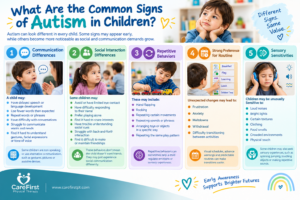
Autism can become noticeable during early childhood, although every child develops at their own pace. Some signs may appear during infancy or toddlerhood, while others become more obvious as social and communication demands increase.
Common signs can include:
1. Communication Differences
A child may:
- Have delayed speech or language development
- Use fewer words than expected for their age
- Repeat words or phrases
- Have difficulty starting or maintaining conversations
- Struggle to communicate wants and needs
- Have difficulty understanding gestures, facial expressions, or tone of voice
Some autistic children are non-speaking or use alternative forms of communication, such as gestures, picture-based communication, or assistive communication devices.
2. Social Interaction Differences
Some children may:
- Avoid or have limited eye contact
- Have difficulty responding to their name
- Prefer playing alone
- Find it difficult to share interests with others
- Have trouble understanding social cues
- Struggle with back-and-forth interaction
- Find it difficult to make or maintain friendships
These behaviors do not necessarily mean that a child does not want friends or relationships. Sometimes the child may simply experience social communication differently.
3. Repetitive Behaviors
Repetitive behaviors are another common characteristic of autism.
These may include:
- Hand flapping
- Rocking
- Repeating certain movements
- Repeating sounds or phrases
- Arranging toys or objects in a particular way
- Repeating the same play pattern
Repetitive behaviors can sometimes help a child regulate emotions or sensory experiences.
4. Strong Preference for Routine
Some autistic children feel more comfortable when their day follows a predictable routine.
Unexpected changes may lead to:
- Frustration
- Anxiety
- Meltdowns
- Withdrawal
- Difficulty transitioning from one activity to another
Visual schedules, advance warnings, and predictable routines can often make transitions easier.
5. Sensory Sensitivities
Children with autism may experience sensory information differently.
They may be unusually sensitive to:
- Loud noises
- Bright lights
- Certain textures
- Clothing
- Food smells
- Crowded environments
- Physical touch
Other children may actively seek sensory experiences, such as spinning, jumping, touching objects, or making repetitive sounds.
Does Every Child With These Signs Have Autism?
No.
Speech delays, difficulty interacting socially, repetitive behaviors, attention difficulties, anxiety, hearing problems, and sensory sensitivities can occur for many different reasons.
That is why parents should not try to diagnose autism based on a checklist alone.
If you notice developmental differences or have concerns about your child’s behavior or communication, speak with your child’s pediatrician or a qualified developmental professional. A proper evaluation can help determine what kind of support your child may need.
How Is Autism Diagnosed?
There is no single blood test or medical scan that can diagnose autism.
A professional evaluation generally looks at a child’s:
- Developmental history
- Communication skills
- Social interaction
- Behavior
- Play skills
- Repetitive behaviors
- Sensory responses
- Adaptive or daily-living skills
Parents and caregivers play an important role because they can provide information about what they observe at home and in other environments.
Depending on the child’s needs, the evaluation may involve professionals from different disciplines.
The earlier developmental concerns are discussed with a professional, the sooner appropriate support can begin.
Why Is Early Intervention Important?
Children’s brains develop rapidly during the early years. This makes early support particularly valuable.
Early intervention does not guarantee a particular outcome, but it can provide children with opportunities to practice important skills in a structured and supportive environment.
Therapy may help a child:
- Communicate more effectively
- Develop social interaction skills
- Manage difficult behaviors
- Improve emotional regulation
- Build independence
- Improve daily-living skills
- Participate more successfully at home and school
- Develop confidence in everyday situations
Most importantly, therapy should be individualized to the child’s strengths, needs, preferences, and goals.
What Types of Therapy Can Help Children With Autism?
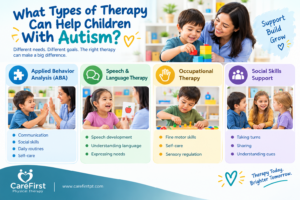
There is no single therapy that is right for every autistic child. A child’s treatment plan should be based on their individual needs.
Applied Behavior Analysis (ABA)
ABA is one approach that may be used to support children with autism.
It focuses on understanding how behaviors occur and teaching useful skills through structured learning and reinforcement.
Depending on the child’s goals, ABA-based intervention may address:
- Communication
- Social skills
- Following instructions
- Self-care
- Classroom readiness
- Daily routines
- Functional skills
- Reducing behaviors that interfere with learning or safety
Quality care should be individualized and focused on meaningful outcomes rather than simply making a child appear “less autistic.”
Speech and Language Therapy
Speech-language therapy can help children develop communication skills.
It may support:
- Speech development
- Understanding language
- Expressing needs
- Conversation skills
- Social communication
- Alternative and augmentative communication (AAC)
For children who do not communicate through speech, AAC can provide another way to express wants, needs, thoughts, and feelings.
Occupational Therapy
Occupational therapy can help children develop skills needed for everyday life.
Depending on the child’s needs, an occupational therapist may work on:
- Fine motor skills
- Self-care
- Dressing
- Feeding
- Sensory regulation
- Handwriting
- Play skills
- Classroom participation
Social Skills Support
Some children need additional opportunities to practice social communication.
Therapy and structured activities can help children learn skills such as:
- Taking turns
- Sharing
- Starting interactions
- Understanding personal space
- Recognizing social cues
- Participating in group activities
Read More: 5 Common Orthopedic Injuries That Can Benefit From Physical Therapy
What Can Parents Do at Home?

Therapy does not only happen inside a therapy room. Parents and caregivers can play an important role in supporting development at home.
Create Predictable Routines
A consistent routine can help a child understand what to expect next.
Simple visual schedules, timers, and advance warnings can make transitions easier.
Follow Your Child’s Interests
If your child loves trains, animals, puzzles, music, or another activity, use that interest as an opportunity for communication and learning.
For example, you can encourage your child to request a toy, take turns, identify objects, or practice simple conversations through an activity they already enjoy.
Give Simple, Clear Instructions
Long or complicated instructions can sometimes be overwhelming.
Instead of giving several directions at once, try breaking a task into smaller steps.
Celebrate Progress
Progress may look different for every child.
For one child, it might be saying a new word. For another, it could be independently putting on shoes, tolerating a new activity, asking for help, or participating in a group.
Small steps are still meaningful progress.
Work With Your Child’s Therapy Team
Ask your child’s therapists what skills you can practice naturally at home.
Consistency between therapy, home, and school can help children use their skills across different environments.
What About School Support?
Children with autism may benefit from additional support in educational settings.
Depending on the child’s individual needs, support may include:
- Individualized learning strategies
- Visual supports
- Communication accommodations
- Behavioral support
- Occupational or speech services
- Structured routines
- Additional transition support
Parents can work with their child’s school to understand available educational services and determine what accommodations or supports may be appropriate.
Autism and Sensory Overload: What Parents Should Know
A busy shopping center, a noisy classroom, or a crowded birthday party may feel very different to a child with sensory sensitivities.
When a child becomes overwhelmed, they may cry, cover their ears, run away, become upset, or withdraw.
Rather than assuming the child is simply being “difficult,” parents can look for possible triggers.
Helpful strategies may include:
- Reducing unnecessary noise
- Providing a quiet space
- Preparing the child for unfamiliar environments
- Using visual schedules
- Allowing appropriate sensory breaks
- Working with an occupational therapist when sensory concerns significantly affect daily life
Understanding the reason behind a behavior can often help families respond more effectively.
Can Autism Be Cured?
Autism is not something that should be thought of as an illness that needs to be “cured.”
Autistic people remain autistic throughout life, although their skills, support needs, and ways of communicating can change over time.
The purpose of therapy is to help a child develop useful skills, communicate effectively, participate in daily life, and achieve greater independence and quality of life.
A good therapy program should respect the child’s dignity and individuality while addressing skills that are genuinely meaningful to the child and family.
Autism Support for Older Children and Adults
Although autism is often discussed in relation to young children, autism is a lifelong developmental condition.
Children eventually become teenagers and adults, and some may continue to need support with communication, social interaction, employment, independent living, emotional regulation, or daily activities.
This is important for families seeking long-term support: autism services should not be viewed only as early-childhood care.
Support should evolve as the person’s needs and goals change.
What About Senior Citizens?
Autism itself is not something that develops simply because someone becomes a senior citizen.
Some older adults may have been autistic throughout their lives but never received a diagnosis, particularly if they learned to compensate for or mask their differences.
However, new communication, memory, behavioral, or social changes in an older adult should not automatically be attributed to autism. Other medical, neurological, or psychological conditions can cause changes later in life and should be evaluated by an appropriate healthcare professional.
For that reason, children, adults, and older adults may require very different types of assessment and support.
Finding the Right Autism Therapy Provider
Choosing the right autism therapy provider is an important decision for families. CareFirst can help children with autism through individualized, child-centered therapy focused on their unique needs and goals. Their support can help children develop communication, social, behavioral, and everyday living skills while providing a safe and supportive environment.
Parents should also ask about treatment goals, progress tracking, therapy methods, and how they can be involved in their child’s development.
When Should You Seek Professional Help?
Consider discussing your concerns with a pediatrician or developmental professional if your child:
- Is not meeting expected developmental milestones
- Has lost previously acquired language or social skills
- Does not respond consistently to their name
- Has significant communication difficulties
- Shows persistent repetitive behaviors
- Has intense difficulty with changes in routine
- Experiences significant sensory challenges
- Struggles to participate in everyday activities
You do not need to wait until your concerns become severe.
If something about your child’s development worries you, bringing it up with a professional is a reasonable first step.
Final Verdict
Autism can make some parts of childhood more challenging, but a diagnosis does not define a child’s potential.
Every autistic child is different. Some may need significant support with communication and daily activities, while others may need help primarily with social interaction, sensory regulation, or adapting to change.
The most important step is understanding the child rather than focusing only on the diagnosis.
If you are concerned about your child’s development, don’t be afraid to ask questions or seek a professional evaluation. With individualized therapy, family involvement, appropriate educational support, and a compassionate environment, children with autism can build valuable skills and work toward greater independence.
For parents in Cary, North Carolina, finding the right therapy provider can be an important part of creating a support system that grows with your child.
The goal isn’t to make every child fit the same mold. The goal is to give each child the tools, communication, support, and confidence they need to thrive.
Read More: How Physical Therapy Helps Restore Strength After a Long Period of Inactivity
Frequently Asked Questions About Autism
1. What are the first signs of autism in a child?
Early signs can include differences in eye contact, response to name, gestures, communication, social interaction, play, repetitive behaviors, and responses to sensory experiences. Not every child will show the same signs.
2. At what age can autism be diagnosed?
Autism can sometimes be identified during the toddler years, although the timing of diagnosis varies from child to child. A professional evaluation is necessary because development differs between children.
3. Can a child outgrow autism?
Autism is a lifelong developmental condition. However, children can learn new skills and may require different levels of support as they grow.
4. What is the best therapy for autism?
There is no single “best” therapy for every child. The appropriate approach depends on the child’s communication, behavioral, sensory, developmental, and daily-living needs.
5. Does speech therapy help autistic children?
Speech-language therapy can help many autistic children develop communication and social communication skills. It can also support children who use AAC or other forms of communication.