
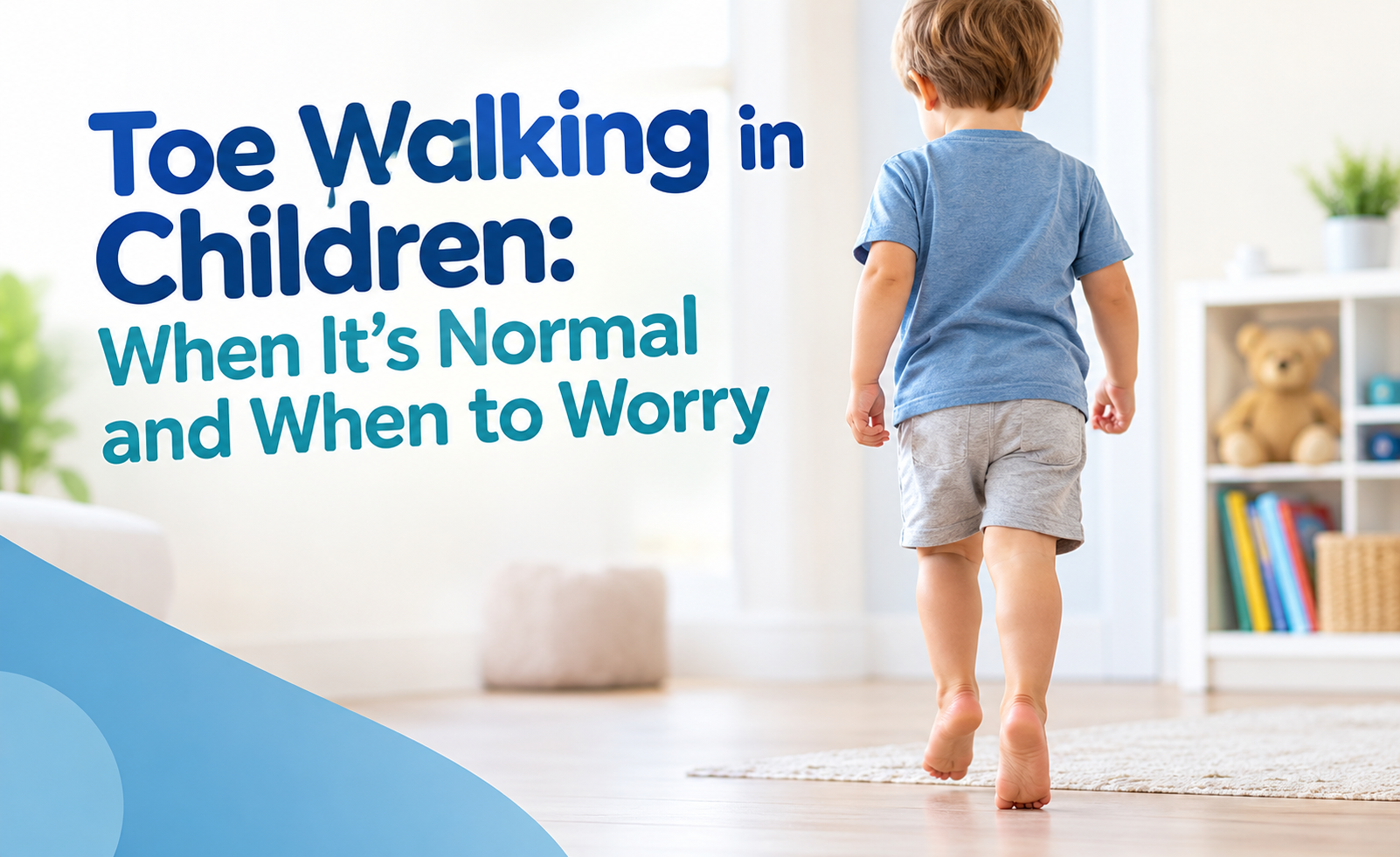
You watch your toddler race across the living room, and you notice they’re up on their tiptoes again. Maybe it only happens when they’re excited. Maybe it’s every step. Either way, a question starts nagging at you: Is this normal, or should I be worried?
The short answer is that toe walking is common in young children, and often it’s nothing serious. But in some cases it points to something that deserves a closer look. This guide explains what’s typical, what isn’t, and when physical therapy can help.
What Is Toe Walking?
Toe walking means a child walks on the balls of their feet without the heel touching the ground. Some children do it occasionally, while others do it most or all of the time.
It’s important to separate two things:
- Occasional toe walking: a child can walk with a flat foot but sometimes chooses to go on tiptoes, such as when playing, excited, or pretending
- Persistent toe walking: a child walks on their toes most of the time, or struggles to put their heels down even when asked
The pattern matters more than any single moment.
Read More: Flat Head Syndrome (Plagiocephaly) in Babies: Prevention and Physical Therapy
When Toe Walking Is Normal
When children first learn to walk, many go through a phase of walking on their toes. It’s considered within the range of normal in toddlers, especially during the first year or two of walking.
Toe walking is more likely to be a typical phase if your child:
- Is under about 2 years old and recently started walking
- Walks flat-footed at least some of the time
- Can stand with their heels on the floor comfortably
- Can squat and play without difficulty
- Is meeting other developmental milestones
- Has no pain, stiffness, or weakness
- Shows steady improvement, with more flat-footed walking over time
Most children outgrow it by around age 2 to 3. Because every child is different, some take a little longer.

When Toe Walking Is a Concern
It’s worth getting a professional opinion if your child:
- Is still toe walking after age 2 to 3, particularly if it happens most of the time
- Can’t or won’t put their heels down, even when asked or while standing
- Has tight or stiff calves or ankles
- Has toe walking on only one side
- Falls or trips often, or seems clumsy
- Seems weak, tires easily, or has trouble climbing stairs or getting up from the floor
- Has leg pain, cramping, or complains of foot discomfort
- Is delayed with milestones such as sitting, crawling, walking, or speech
- Has a family history of toe walking
- Has been diagnosed with, or is being evaluated for, a developmental, sensory, or neurological condition
- Has lost skills they previously had, such as walking flat-footed, or has regressed
Having one of these signs doesn’t mean something is wrong, but it’s a good reason to ask.
Why Do Kids Walk on Their Toes?

There are several possible reasons. Often the cause is straightforward, but sometimes an underlying condition is involved, which is why a proper evaluation matters.
Idiopathic toe walking
“Idiopathic” means no specific cause is found. This is the most common diagnosis when a healthy child persistently walks on their toes. These children often can put their heels down when asked, but prefer not to. It sometimes runs in families, and may come with tight calf muscles over time.
Tight calf muscles or Achilles tendon
If the calf muscles or Achilles tendon are short or tight, the heel may not reach the floor comfortably. Sometimes this tightness is the cause, and sometimes it develops because a child has been toe walking for a long time.
Sensory preferences
Some children seek or avoid certain sensations, and walking on their toes may reduce how much of the foot touches the ground. Sensory processing differences are one possible factor, which is where occupational therapy can also be helpful.
Developmental or neurodevelopmental conditions
Toe walking is more common in children with autism spectrum disorder, speech and language delays, and developmental coordination differences. It doesn’t mean a child has one of these conditions, but it can be one part of the bigger picture.
Neurological or muscular conditions
Less commonly, toe walking can be associated with conditions such as cerebral palsy, muscular dystrophy, or spinal cord and nerve problems. These children usually have other signs, such as stiffness, weakness, coordination problems, or lost skills, and it’s why a persistent or one-sided pattern should be checked.
Other causes
- Differences in leg length or joint problems
- A habit that developed after an injury or illness
- Shoes, clothing, or footwear that influence posture
Read More: W-Sitting in Children: Is It Bad for Kids?
What Happens at an Evaluation?
A pediatrician is a great first stop, and they may refer you to a pediatric physical therapist, a specialist, or both. An evaluation may include:
- A history of your child’s development, walking, and any family history
- Observing how your child walks, runs, and stands
- Measuring ankle and calf flexibility
- Checking strength, balance, and coordination
- Looking at muscle tone and reflexes
- Screening for neurological or developmental concerns
- Noting sensory preferences
This helps determine whether toe walking is a harmless habit, a tightness issue, or a sign that something else needs attention.
Does Toe Walking Need Treatment?
It depends on the cause, the child’s age, and how stiff the ankles are. Options might include:
- Watchful waiting for toddlers who are otherwise developing normally and can walk flat-footed
- Physical therapy to improve flexibility, strength, and walking pattern
- Stretching and positioning programs at home
- Orthotics or braces, such as ankle-foot orthoses, in some cases
- Serial casting, where gentle casts are changed gradually to lengthen tight muscles
- Medical or surgical options, such as botulinum toxin injections or, rarely, tendon lengthening, for more persistent or severe cases
- Treatment of an underlying condition, when one is found
Your child’s care team will recommend what fits their situation.
How Pediatric Physical Therapy Helps
Physical therapy is often the first-line approach for children who persistently toe walk. A pediatric physical therapist looks at the whole child, not just their feet. Treatment is play-based, so it feels like fun, and may include:
- Calf and ankle stretching done in gentle, age-appropriate ways
- Strengthening the muscles that help lift the front of the foot and control the ankle, as well as the core and hips
- Balance and coordination activities, such as walking on varied surfaces, stepping stones, and obstacle courses
- Gait training with cues and games that encourage a heel-toe pattern
- Heel-down practice during activities like squatting, crab walking, and playing on a slight incline
- Parent coaching with simple things to do during daily routines
- Guidance on footwear and orthotics, and coordination with your child’s doctor if bracing or casting is considered
- Sensory-friendly strategies, and referrals to occupational therapy if sensory needs are a factor
Results vary by child. Early support gives your child more time to build healthy walking habits while their bodies are still growing, and gives you answers sooner.
Simple Things You Can Try at Home

These are general ideas, and a therapist can tailor them to your child.
- Encourage barefoot play on safe, varied surfaces, such as grass, carpet, and sand, which gives helpful feedback to the feet
- Make heel-down games: squat to play, animal walks (bear walk, crab walk), and jumping games
- Try stretching through play, such as sitting with legs outstretched while reading a book
- Offer supportive shoes that fit well and don’t force the toes upward or tip the child forward
- Give gentle, positive reminders rather than constant correction, since pressure can backfire
- Watch and note patterns, such as when it happens (excited, tired, barefoot) and whether it’s both feet or one
Avoid forcing stretches or pushing through discomfort. If your child resists or seems to be in pain, stop and ask a professional.
Can Toe Walking Cause Problems Later?
Occasional toe walking in a toddler is not a concern. But persistent toe walking can sometimes lead to:
- Tightening of the calf muscles and Achilles tendon over time
- Reduced ankle motion
- Balance difficulties
- Foot or leg discomfort, or fatigue during activity
- Difficulties with sports and running for some children
This is why a persistent pattern is worth checking rather than waiting indefinitely.
When to Call Your Pediatrician
Contact your child’s doctor if you notice:
- Toe walking that continues past age 2 to 3
- New toe walking in a child who previously walked flat-footed
- Toe walking on one side only
- Stiffness, weakness, or frequent falling
- Pain in the legs, feet, or back
- Regression or loss of skills
- Other developmental concerns, such as delayed speech or social differences
Seek urgent care if a child suddenly can’t walk, becomes weak, or has back pain with changes in bowel or bladder control.
How Care First Rehab Can Help
At Care First Rehab in Cary, NC, our pediatric therapy team helps families understand why their child is walking on their toes and what to do about it. Our care includes:
- A thorough evaluation of your child’s walking pattern, flexibility, strength, and development
- Play-based, family-centered therapy tailored to your child’s needs and interests
- Home programs that are simple enough to fit your family’s routine
- Coordination with your pediatrician and other specialists when needed
- Physical, occupational, and speech therapy under one roof, so we can support related sensory or developmental needs
- In-home therapy and telemedicine options for families who need flexibility
- Two convenient locations in Cary
Read More: BPPV Vertigo: The Epley Maneuver and When to See a Physical Therapist
Walking Tall Doesn’t Have to Mean Walking on Tiptoes
Most toe walking in toddlers is a phase, but if it’s persistent or comes with other signs, early guidance can make a difference. An evaluation brings clarity and a plan, and often peace of mind.
Call Care First Rehab at 919-460-1921 or [book an evaluation online] to talk with our pediatric therapy team.
Frequently Asked Questions
Is toe walking normal for toddlers?
It’s common in the first year or two of walking and often goes away on its own. If it continues past age 2 to 3, or comes with other signs, ask your pediatrician.
At what age should I worry about toe walking?
Persistent toe walking beyond about age 2 to 3 is a good reason for an evaluation. Earlier, any toe walking on one side, stiffness, weakness, or loss of skills should be checked.
Is toe walking a sign of autism?
Toe walking is more common in children with autism, but most toe walkers do not have autism. If you also have concerns about speech, social interaction, or behavior, talk with your pediatrician about a developmental screening.
Can my child outgrow toe walking?
Many children do, especially younger ones with no underlying cause. Some need therapy or other support to develop a heel-toe walking pattern.
Will my child need casts or surgery?
Most children don’t. Many improve with therapy and home programs. More intensive options are typically reserved for persistent cases with significant tightness, and your care team will discuss them if needed.
Can I stretch my child’s calves at home?
Gentle, playful stretching may help, but ask a therapist to show you how, since pushing too hard can cause discomfort and resistance.
Does toe walking hurt?
Many children have no pain at all. If your child complains of leg or foot pain, or cramping, mention it to their doctor.
Do I need a referral to see a pediatric physical therapist?
Requirements vary by insurance and situation, so contact our office and we’ll help you check before your visit.