
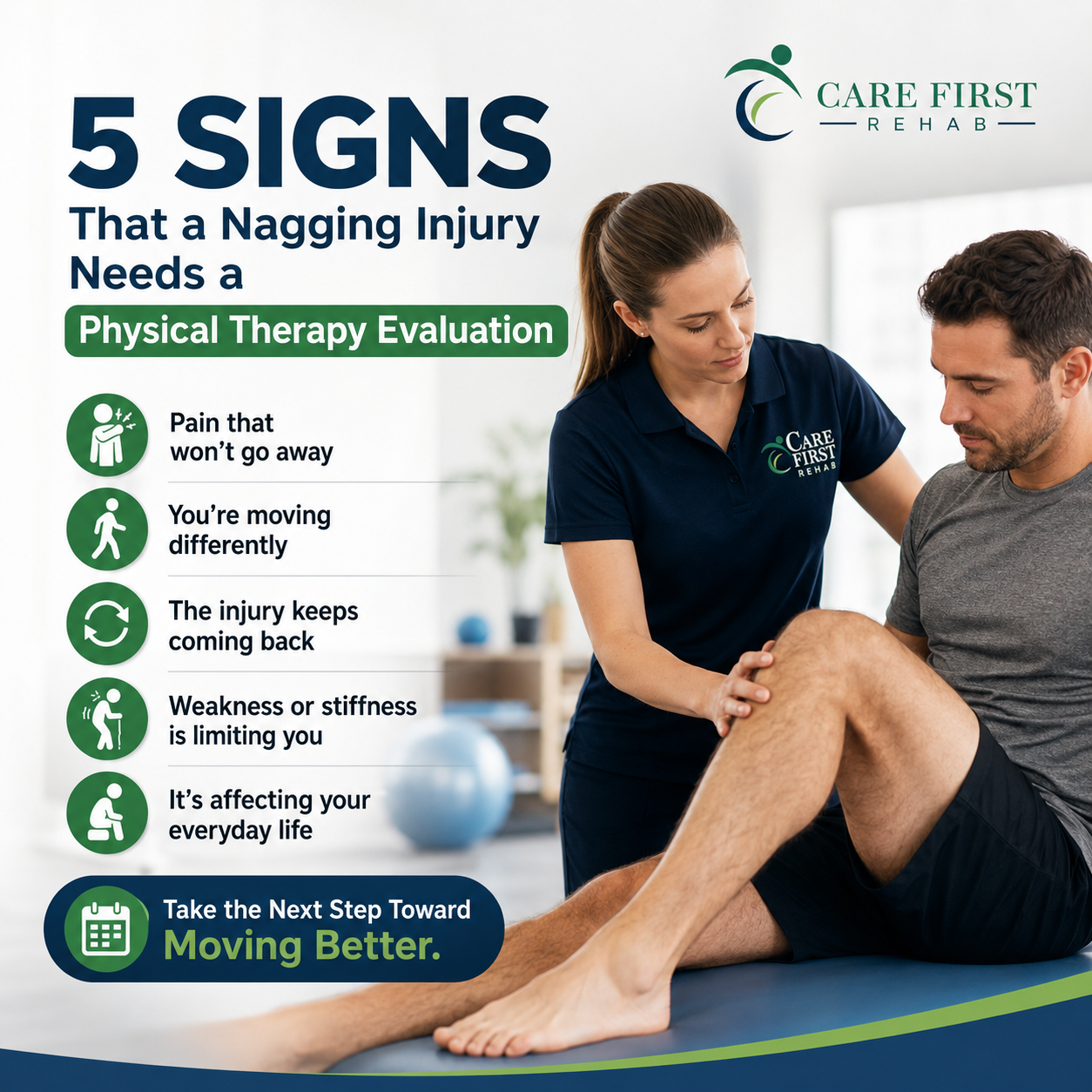
Not every ache or minor injury requires professional treatment. Sometimes, soreness after exercise or a physically demanding activity improves with rest and time. But what happens when that discomfort keeps coming back, affects your movement, or never seems to fully go away?
That lingering problem may be more than something you simply need to “push through.”
A physical therapy evaluation can help determine what may be contributing to persistent pain, stiffness, weakness, or changes in the way you move. Physical therapists look at more than just where it hurts. They evaluate movement, strength, flexibility, balance, coordination, and function to understand how an injury may be affecting your body.
For people in Cary, NC, recognizing the warning signs early can be an important step toward getting back to the activities and routines they enjoy.
Here are five signs that a nagging injury may deserve a physical therapy evaluation.
Read More: Finding the Right Physical Therapist in Cary, NC: What Patients Should Know
1. Your Pain Keeps Hanging Around
Most minor soreness should gradually improve as your body recovers. If the same pain continues to bother you despite giving yourself time to recover, it may be worth having it evaluated.
You may notice discomfort that:
- Has lasted longer than expected
- Returns whenever you become more active
- Gets worse with specific movements
- Makes exercise or work uncomfortable
- Interferes with sleep or everyday activities
Persistent pain doesn’t always mean that you have a serious injury. However, it can indicate that something is preventing your body from returning to normal movement.
For example, weakness, restricted mobility, altered movement patterns, or repetitive stress may continue to place strain on an area even after the original injury has settled down.
During a physical therapy evaluation, your therapist can look at how the affected area functions and how other parts of your body may be contributing to the problem.
The goal isn’t simply to identify where you hurt. It’s to understand why the problem may be continuing.
2. You Have Started Moving Differently
Your body often changes the way it moves when something hurts.
You might avoid putting weight on one leg, use your other arm more, change the way you walk, or avoid reaching, bending, lifting, or turning in a particular direction.
These changes can happen without you realizing it.
At first, altering your movement may feel helpful because it allows you to avoid discomfort. But if the altered pattern continues, other muscles and joints may have to compensate for the injured area.
You may notice things such as:
- Limping when walking
- Avoiding stairs
- Favoring one side of your body
- Changing how you lift objects
- Avoiding certain exercises
- Using your arms to help when standing up
- Feeling uncomfortable with movements that were previously easy
A physical therapist can assess these movement patterns and determine whether limitations in strength, flexibility, balance, or coordination may be affecting how you move.
3. The Injury Keeps Coming Back
One of the most frustrating experiences is feeling better, returning to your normal routine, and then having the same pain return.
Perhaps your knee feels fine until you start running again. Your shoulder improves until you return to overhead activities. Or your back feels better for a few days before becoming uncomfortable again after work.
A recurring injury may be a sign that the original problem hasn’t been fully addressed.
This doesn’t necessarily mean you need to stop being active. Instead, you may need to understand what your body needs before returning to the same level of activity.
A physical therapist can help identify potential contributing factors and create a progressive plan focused on restoring strength, mobility, and functional movement.
The goal is to help you build the capacity to perform your normal activities rather than repeatedly stopping and starting because of the same symptoms.

4. Weakness or Stiffness Is Limiting What You Can Do

Sometimes the biggest warning sign isn’t pain—it’s what you can no longer do comfortably.
Maybe you have noticed that your shoulder doesn’t move as freely as before. Perhaps your knee feels weak when going downstairs, or you have difficulty getting up from a chair. You may also feel stiff after sitting for a long period or struggle to maintain your usual balance.
Changes in physical function can be easy to dismiss, particularly when they develop gradually.
However, reduced strength, flexibility, balance, or endurance can affect how efficiently your body handles everyday demands.
Physical therapy can address these limitations through an individualized treatment program. Depending on your needs, treatment may include therapeutic exercises, mobility activities, strengthening, balance training, movement education, and other appropriate techniques.
Care First Rehab’s physical therapy services focus on helping patients recover from pain and limitations involving flexibility, coordination, balance, endurance, speed, and strength.
5. Your Injury Is Affecting Your Everyday Life

A problem deserves attention when it begins changing the way you live.
You don’t have to be an athlete or have a major injury for physical therapy to be useful. A nagging problem can affect anyone—from someone working at a desk all day to someone who enjoys running, gardening, playing sports, or spending time with family.
Ask yourself:
Is this injury keeping me from doing something I normally enjoy?
You may have stopped exercising because of knee pain, avoided picking up your child because of back discomfort, or started limiting household activities because your shoulder hurts.
When symptoms begin interfering with everyday activities, getting an evaluation can help you understand what is happening and what steps may help you move forward.
Physical therapy is designed around function—not just symptoms. Your therapist can work with you toward meaningful goals, whether that means returning to exercise, moving more comfortably at work, improving balance, or simply making daily activities easier.
Read More: Shoulder Pain 101: Rotator Cuff Injuries and Overuse Explained
Why Should You Get a Physical Therapy Evaluation?
A physical therapy evaluation is an opportunity to look at the bigger picture.
Rather than focusing exclusively on the painful area, a therapist may consider how different parts of your body work together. An evaluation may involve looking at your:
- Range of motion
- Muscle strength
- Flexibility
- Balance
- Coordination
- Movement patterns
- Functional abilities
- Activity limitations
Your therapist can then use those findings to develop a treatment approach based on your individual condition and goals.
This personalized approach matters because two people can have similar symptoms but very different contributing factors.
For one person, weakness may be a major factor. For another, limited mobility or a change in movement mechanics may play a larger role.
Don’t Wait for a Nagging Injury to Become a Bigger Problem
It can be tempting to ignore an injury when the discomfort isn’t severe.
You may tell yourself that you’ll give it another week, take a few days off, or simply work around it. Sometimes that is enough. But when symptoms persist, repeatedly return, or begin changing how you move, continuing to ignore them may keep you from getting back to normal activities.
Physical therapy can also play a role in preventing future problems by helping you understand your body’s movement and strengthening areas that may need additional support.
The earlier you understand what may be contributing to a recurring problem, the sooner you can make informed decisions about your recovery.
When Should You Seek Help?
Consider scheduling a physical therapy evaluation if you notice that:
- Your pain isn’t improving as expected
- Your symptoms repeatedly return
- You have developed weakness or stiffness
- Your normal movement has changed
- Everyday activities have become more difficult
- You have stopped participating in activities you enjoy because of an injury
These signs don’t automatically mean that physical therapy is the right treatment for your specific situation. A qualified healthcare professional can help determine what type of evaluation or care is appropriate.
If you experience severe or sudden symptoms, significant trauma, or symptoms that could indicate a medical emergency, seek appropriate medical care promptly.
Read More: 7 Ways Physical Therapy in Cary, NC Helps You Recover Faster
Take the Next Step Toward Moving Better
A nagging injury doesn’t have to become a permanent part of your routine.
Whether you’re dealing with persistent discomfort, reduced strength, stiffness, balance concerns, or difficulty returning to your normal activities, a physical therapy evaluation can provide a clearer picture of how your body is moving and what may be limiting you.
At Care First Rehab, our therapy specialists work with patients to help them regain or maintain optimal function and health. Our physical therapy services are focused on helping patients improve areas such as strength, flexibility, coordination, balance, endurance, and movement.
If an injury has been holding you back, don’t feel like you have to simply live with it.
Contact Care First Rehab in Cary, NC to learn more about scheduling a physical therapy evaluation and taking the next step toward moving with greater confidence.