
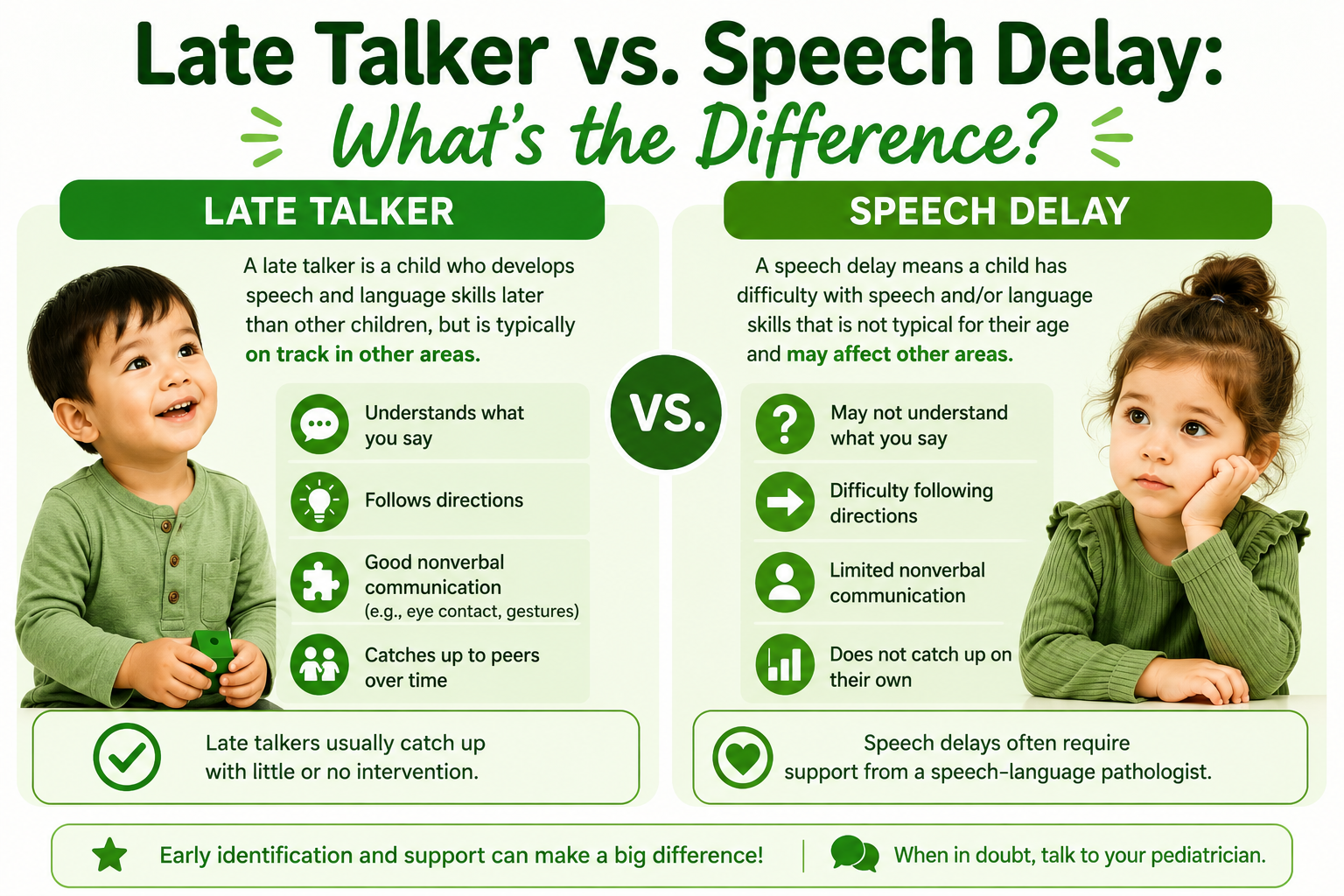
Every child develops at their own pace, especially when it comes to communication. However, when a child isn’t speaking as expected for their age, many parents begin to wonder: Is my child simply a late talker, or could it be a speech delay?
Understanding the difference is important because early identification and intervention can significantly improve a child’s communication skills and overall development. In this guide, we’ll explain the key differences between late talking and speech delays, common warning signs, and when it’s time to seek professional support.
What Is a Late Talker?
A late talker is a child who develops language skills more slowly than their peers but continues to show typical development in other areas such as play, social interaction, learning, and motor skills.
Late talkers generally:
- Understand language appropriate for their age.
- Follow simple instructions.
- Use gestures such as pointing or waving.
- Engage socially with family members and peers.
- Show steady progress in communication over time.
Many late talkers eventually catch up to their peers without long-term language difficulties. However, monitoring their development remains important.
You can also read: Pediatric Care: Why and When Does a Child Need Medical Care?
What Is a Speech Delay?
A speech delay occurs when a child’s speech and language development is significantly behind expected milestones for their age.
Children with speech delays may experience challenges with:
- Producing sounds correctly.
- Building vocabulary.
- Forming sentences.
- Understanding language.
- Communicating their needs effectively.
Unlike some late talkers, children with speech delays may continue to struggle without professional intervention.

Late Talker vs. Speech Delay: Key Differences
| Development Area | Late Talker | Speech Delay |
| Understanding Language | Usually age-appropriate | May be delayed |
| Social Interaction | Typically normal | May be affected |
| Use of Gestures | Frequently uses gestures | Limited use of gestures |
| Communication Growth | Steady improvement | Slower or limited progress |
| Need for Therapy | Sometimes | Often recommended |
Speech and Language Milestones Parents Should Know
While every child develops differently, certain milestones help indicate whether communication skills are progressing appropriately.
By 12 Months
- Responds to their name
- Uses gestures such as waving
- Babbles regularly
By 18 Months
- Says several meaningful words
- Understands simple directions
- Points to familiar objects
By 24 Months
- Uses at least 50 words
- Combines two-word phrases
- Follows simple instructions
By 3 Years
- Speaks in short sentences
- Is understood by familiar adults most of the time
- Engages in simple conversations
If your child is missing multiple milestones, a professional evaluation may be beneficial.
Signs Your Child May Have a Speech Delay
Parents should consider consulting a speech-language pathologist if their child:
- Is not using words by 18 months.
- Has difficulty understanding simple instructions.
- Struggles to combine words by age 2.
- Is difficult to understand compared to peers.
- Becomes frustrated when trying to communicate.
- Shows limited social interaction.
- Does not make steady progress in speech development.
Early intervention can often improve outcomes and help children develop stronger communication skills.
Why Early Evaluation Matters
Research consistently shows that early intervention can make a significant difference in a child’s communication development. Identifying challenges early allows therapists to create individualized treatment plans that support speech, language, and social communication skills during critical developmental years.
Waiting to see if a child “outgrows” communication difficulties may delay access to beneficial support services.
How Speech Therapy Can Help
Speech therapy focuses on helping children develop effective communication skills through evidence-based techniques and engaging activities tailored to their specific needs.
Speech therapy may help children:
- Improve speech clarity and pronunciation.
- Expand vocabulary and language skills.
- Strengthen listening and comprehension abilities.
- Improve social communication.
- Build confidence when interacting with others.
Therapy programs are customized based on each child’s developmental level and communication goals.
Why Families Choose Care First Rehabilitation
At Care First Rehabilitation, experienced speech-language pathologists provide comprehensive evaluations and personalized therapy programs designed to help children develop strong communication skills.
The team works closely with families to:
- Assess speech and language development.
- Identify communication challenges early.
- Create individualized treatment plans.
- Support children in achieving age-appropriate communication milestones.
- Provide family-centered care focused on long-term success.
Whether your child is a late talker or experiencing a speech delay, professional guidance can help determine the best path forward.
Take the Next Step
If you’re concerned about your child’s speech or language development, don’t wait to seek answers.
Care First Rehabilitation offers professional speech therapy services to help children build confidence, improve communication skills, and reach their full potential.
👉 Schedule a speech and language evaluation today:
https://carefirstpt.com/speech-therapy/
Early support can make a lasting difference in your child’s future communication success.
Frequently Asked Questions
Can a late talker catch up without therapy?
Some late talkers naturally catch up to their peers. However, an evaluation can help determine whether additional support may be beneficial.
What age should I be concerned about speech delay?
Parents should discuss concerns with a healthcare provider or speech-language pathologist if developmental milestones are significantly delayed, especially after age 2.
Is speech delay a sign of autism?
Speech delay can occur for many reasons and does not automatically indicate autism. A professional evaluation can help identify the underlying cause.
How long does speech therapy take?
The duration varies depending on the child’s needs, developmental goals, and consistency of therapy.
Does early speech therapy make a difference?
Yes. Early intervention is often associated with improved communication outcomes and better long-term developmental progress.