
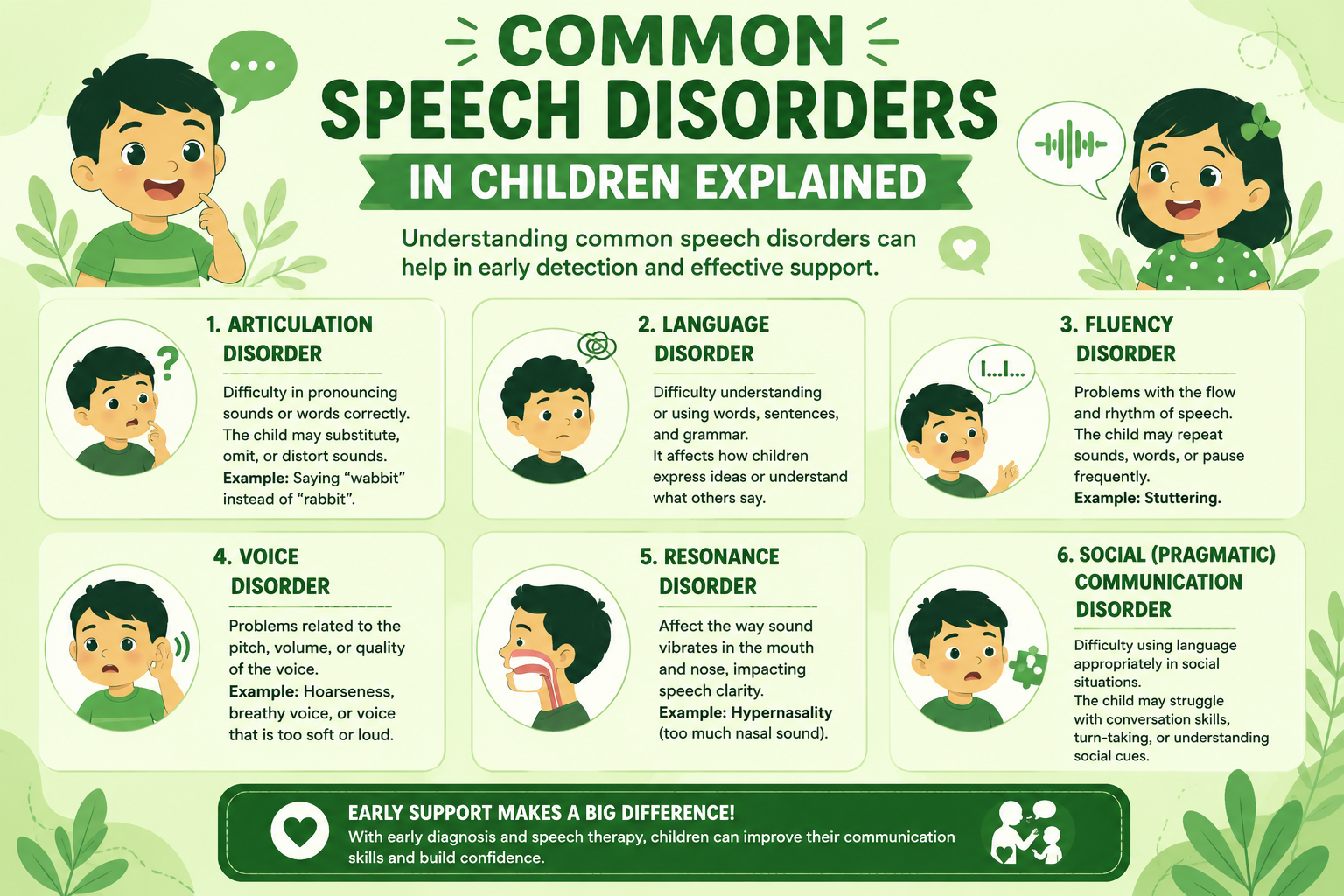
Communication is an essential part of a child’s growth and development. While every child develops speech and language skills at their own pace, some children experience difficulties that affect how they speak, understand, or express themselves.
Understanding the common speech disorders in children can help parents recognize potential concerns early and seek appropriate support. Early intervention often leads to better outcomes and can help children develop the communication skills they need for success at home, school, and in social settings.
What Are Speech Disorders?
Speech disorders affect a child’s ability to produce sounds correctly, speak fluently, or use their voice effectively. These challenges can make it difficult for others to understand what a child is trying to communicate.
Speech disorders are different from language disorders, which involve difficulties understanding or using words and sentences. However, some children may experience both speech and language difficulties simultaneously.
Signs of Speech Disorders in Children
Parents should pay attention to signs such as:
- Difficulty pronouncing words clearly
- Speech that is hard to understand compared to peers
- Repeating sounds or words frequently
- Struggling to form sentences
- Limited vocabulary for age
- Frustration during communication
- Difficulty following verbal instructions
- Voice that sounds unusually hoarse, nasal, or strained
If these concerns persist, a speech-language evaluation may be beneficial.

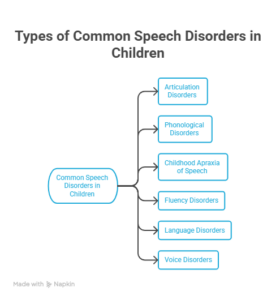
Types of Common Speech Disorders in Children
1. Articulation Disorders
Articulation disorders occur when a child has difficulty producing specific speech sounds correctly.
Examples include:
- Saying “wabbit” instead of “rabbit”
- Saying “thun” instead of “sun”
- Omitting sounds in words
Children with articulation disorders know what they want to say but struggle to physically produce certain sounds accurately.
Common Signs
- Sound substitutions
- Sound omissions
- Distorted speech sounds
- Difficulty being understood
2. Phonological Disorders
A phonological disorder involves patterns of sound errors rather than difficulty producing individual sounds.
For example:
- Consistently leaving off ending sounds
- Simplifying complex words
- Replacing groups of sounds with easier ones
Unlike articulation disorders, the issue lies in understanding and organizing sound patterns within language.
Common Signs
- Frequent speech sound errors
- Difficulty following age-appropriate speech patterns
- Reduced speech intelligibility
3. Childhood Apraxia of Speech (CAS)
Childhood Apraxia of Speech is a motor speech disorder that affects the brain’s ability to plan and coordinate speech movements.
Children with apraxia know what they want to say but have difficulty coordinating the movements required to produce words correctly.
Common Signs
- Inconsistent speech errors
- Difficulty combining sounds
- Delayed speech development
- Trouble imitating words
- Speech that sounds effortful
Early diagnosis and specialized therapy are important for children with apraxia.
4. Fluency Disorders (Stuttering)
Stuttering is one of the most common fluency disorders in children.
It may involve:
- Repeating sounds or syllables
- Prolonging sounds
- Blocking or getting stuck while speaking
Common Signs
- Repetition of words or sounds
- Pauses during speech
- Visible tension when speaking
- Avoiding certain words or situations
Many young children experience temporary disfluencies, but persistent stuttering may require professional evaluation.
5. Language Disorders
Although technically different from speech disorders, language disorders frequently occur alongside speech challenges.
Children may have difficulty:
- Understanding language
- Learning new vocabulary
- Following directions
- Forming sentences
- Expressing thoughts clearly
Language disorders can impact academic performance and social interactions if left untreated.
6. Voice Disorders
Voice disorders affect the quality, pitch, volume, or resonance of a child’s voice.
Common Signs
- Persistent hoarseness
- Breathy voice
- Unusually loud or soft voice
- Nasal-sounding speech
- Vocal strain
Voice disorders may result from vocal misuse, medical conditions, or structural differences affecting the voice.
What Causes Speech Disorders in Children?
Speech disorders can develop for various reasons, including:
Developmental Factors
Some children naturally experience delays in speech development.
Hearing Problems
Hearing difficulties can affect a child’s ability to learn speech sounds accurately.
Neurological Conditions
Conditions affecting brain development may impact speech and language skills.
Oral-Motor Challenges
Weakness or coordination difficulties involving the lips, tongue, and jaw can affect speech production.
Genetic Factors
Family history may contribute to speech and language difficulties.
In many cases, no single cause is identified.
When Should Parents Seek Professional Help?
Parents should consider a speech-language evaluation if their child:
- Is difficult to understand compared to peers
- Misses age-appropriate speech milestones
- Shows frustration when communicating
- Stutters persistently
- Has trouble following directions
- Experiences significant speech sound errors
- Demonstrates limited progress over time
Early intervention can help address concerns before they affect learning, confidence, and social development.
How Speech Therapy Helps Children
Speech therapy is tailored to each child’s individual needs and communication goals.
A speech-language pathologist may help children:
- Improve speech clarity
- Correct sound production errors
- Increase vocabulary and language skills
- Develop fluency skills
- Strengthen social communication
- Improve confidence when speaking
Therapy often includes engaging activities, games, and family involvement to encourage progress.
Why Families Choose Care First Rehabilitation
At Care First Rehabilitation, experienced speech-language pathologists provide comprehensive evaluations and individualized treatment plans for children with speech and language challenges.
Their team helps children with:
- Articulation disorders
- Speech delays
- Childhood apraxia of speech
- Stuttering and fluency disorders
- Language delays
- Social communication difficulties
- Autism-related communication challenges
Using evidence-based therapy techniques, Care First Rehabilitation works closely with families to help children reach their full communication potential.
Schedule a Speech Evaluation Today
If you’re concerned about your child’s speech development, early support can make a meaningful difference.
Care First Rehabilitation offers personalized speech therapy services designed to help children communicate more clearly and confidently.
👉 Learn more or schedule an evaluation today:
https://carefirstpt.com/speech-therapy/
Frequently Asked Questions
What is the most common speech disorder in children?
Articulation disorders are among the most commonly diagnosed speech disorders in children.
Can speech disorders improve with therapy?
Yes. Many children make significant progress with early and consistent speech therapy.
At what age should speech concerns be evaluated?
Parents should seek guidance whenever developmental concerns arise. Early intervention is often most effective.
Is stuttering normal in young children?
Some temporary stuttering can occur during language development, but persistent stuttering should be evaluated by a speech-language pathologist.
How long does speech therapy take?
The length of therapy varies depending on the child’s diagnosis, goals, and individual progress. Early intervention often leads to better outcomes.